Verse and Hard Line Breaks
Verse with short lines—reflow it or keep each line?
✅ NormativeSettled. The requirement holds as written.📄 Page ruleCan be applied from the page alone.Read §7.2.13 in the RFC ↗
Text whose line breaks carry meaning — verse, song text, deliberately broken lines — MUST be
written one printed line per source line, separated by a plain newline, and MUST NOT be reflowed
into running prose. No trailing spaces, no <br>, no fenced block: the same spelling as
Line Breaks Inside a Block (§6.2).
When it applies
Poetry, song text, addresses and deliberately broken lines carry meaning in their line breaks. Markdown joins single newlines into one paragraph when it renders, so the breaks vanish on screen unless they are marked.
your honor
since i've been convicted of murder
and have taken time to digest
just what that means
A plain newline keeps every printed line in the Markdown source, which is what the output is
judged on; a rendered view that joins the lines is a display artefact. Trailing spaces are invisible
and fragile, <br> puts markup on every line, and a fenced block turns the verse into code and loses
its bold and italics. Inline marks stay per line: a bold line is **line**.
Prose has the opposite rule: a line break inside a paragraph is typesetting, and the sentence is joined. The question is only how to mark the lines when the break is the content. A verse line that is too long for its column and wraps is still one line: the wrap is joined like prose.
Reading the examples. Each one pairs a source page with the output the rule expects. ✅ Sample: the rule applies. ❌ Counter-sample: it looks like it applies and does not, or a rendering got it wrong. A non-conforming output, in red, is shown only for contrast. … marks content left out of an excerpt.
Examples
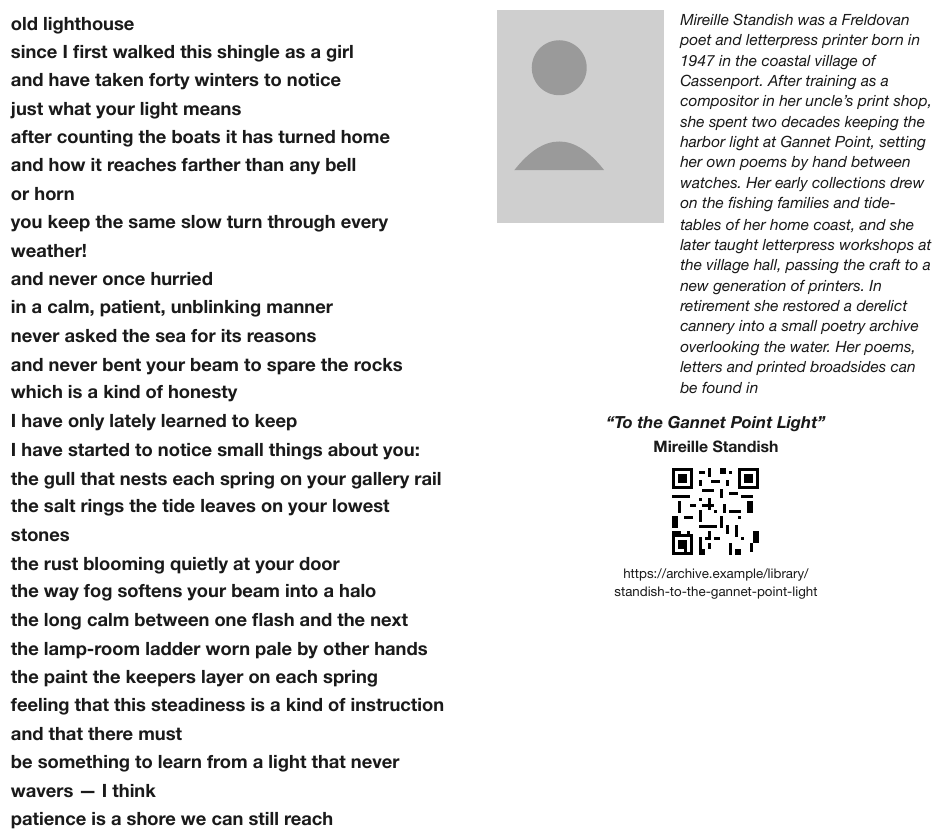
a poem beside a biography
The left column is verse, set in bold: short lines, no punctuation at most line ends, each break
intentional. Three lines are too long for the column and wrap (… through every / weather!,
… on your lowest / stones, … that never / wavers — I think); each is one verse line. The
right column is ordinary prose that wraps, then a QR code with its URL printed across two lines
beneath it.
Source page
Expected output · excerpt, the verse column
old lighthouse since I first walked this shingle as a girl and have taken forty winters to notice just what your light means after counting the boats it has turned home and how it reaches farther than any bell or horn you keep the same slow turn through every weather! and never once hurried in a calm, patient, unblinking manner never asked the sea for its reasons and never bent your beam to spare the rocks which is a kind of honesty I have only lately learned to keep I have started to notice small things about you: the gull that nests each spring on your gallery rail the salt rings the tide leaves on your lowest stones the rust blooming quietly at your door the way fog softens your beam into a halo the long calm between one flash and the next the lamp-room ladder worn pale by other hands the paint the keepers layer on each spring feeling that this steadiness is a kind of instruction and that there must be something to learn from a light that never wavers — I think patience is a shore we can still reach
…
Neighbouring rules, and how they differ
More
Rule id text-verse-and-hard-line-breaks · text formatting line-breaks