Drop Caps
A large initial letter—part of the word or separate?
✅ NormativeSettled. The requirement holds as written.📄 Page ruleCan be applied from the page alone.Read §7.2.3 in the RFC ↗
A drop cap MUST be joined directly to the rest of its word, with no space, line break or styling added. The output MUST NOT mark the letter as bold, enlarged or otherwise distinct.
When it applies
A drop cap is an enlarged first letter, sunk two or more lines into the opening paragraph. The letter belongs to the first word; the text layer often separates it, and a line-by-line reading puts the rest of the word on a different line from its initial.
T  he modern Recreational Boating Safety (RBS)
   Program traces its inception to the Federal Boat
   Safety Act (FBSA) of 1971.
Reading the examples. Each one pairs a source page with the output the rule expects. ✅ Sample: the rule applies. ❌ Counter-sample: it looks like it applies and does not, or a rendering got it wrong. A non-conforming output, in red, is shown only for contrast. … marks content left out of an excerpt.
Requirements
- The initial MUST be joined to its word. The page prints one word in two sizes, not two words.
- The letter MUST NOT be bolded, enlarged or otherwise marked. Size here is typography, not emphasis — the same reasoning as Bold and Italics (§7.2.1).
- A decorated or ornamental initial is treated the same way: it is still the letter.
- The letter MUST be read from the image, not the text layer — see Cell Text Fidelity (§9.6.3). A legible initial MUST NOT be dropped or replaced by the text layer's reading.
a magazine opener
The article opens with a three-line "T"; the first word is "The". The text layer of the file splits
it as T then he.
Source page
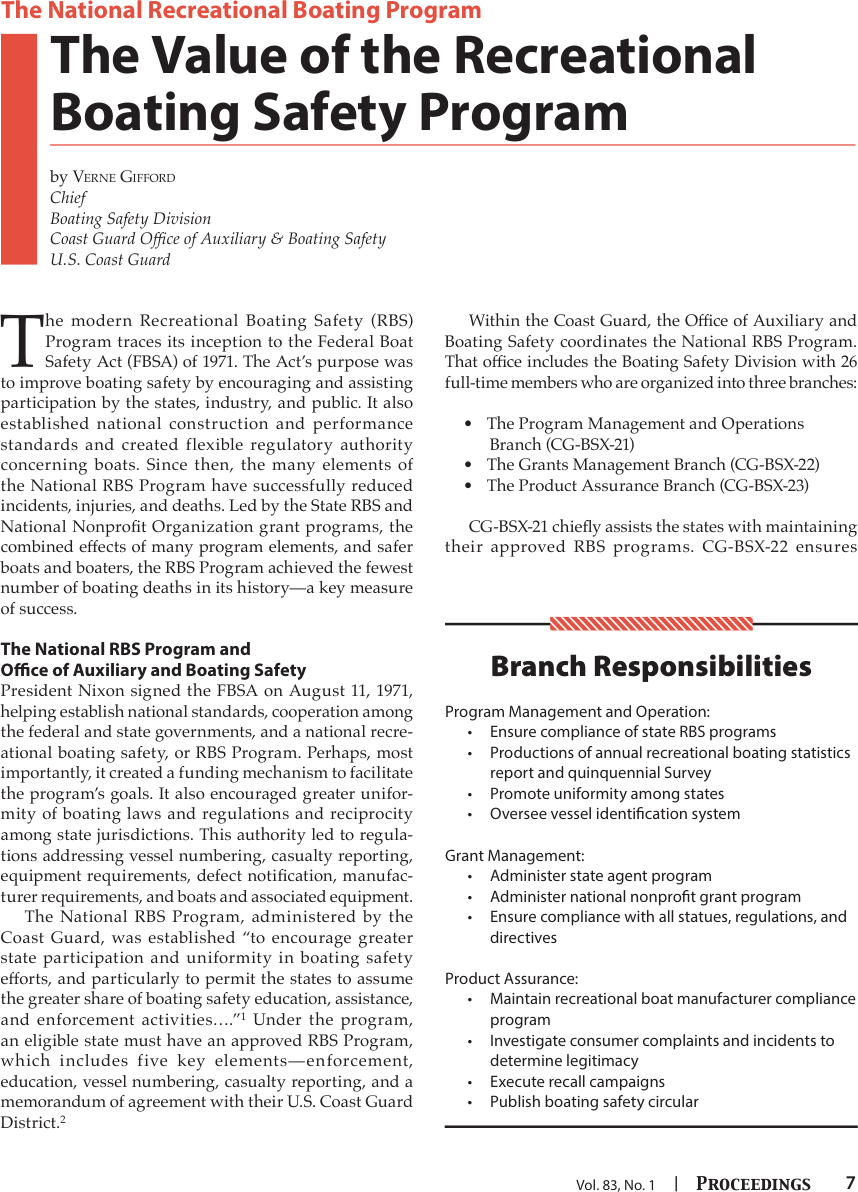
Source: U.S. Coast Guard, "The Value of the Recreational Boating Safety Program" by Verne Gifford, Chief, Boating Safety Division, Proceedings Vol. 83 No. 1, p.7 (public domain)
Expected output · excerpt, first paragraph
The modern Recreational Boating Safety (RBS) Program traces its inception to the Federal Boat Safety Act (FBSA) of 1971. The Act’s purpose was to improve boating safety by encouraging and assisting participation by the states, industry, and public. It also established national construction and performance standards and created flexible regulatory authority concerning boats. Since then, the many elements of the National RBS Program have successfully reduced incidents, injuries, and deaths. Led by the State RBS and National Nonprofit Organization grant programs, the combined effects of many program elements, and safer boats and boaters, the RBS Program achieved the fewest number of boating deaths in its history—a key measure of success.
a journal article
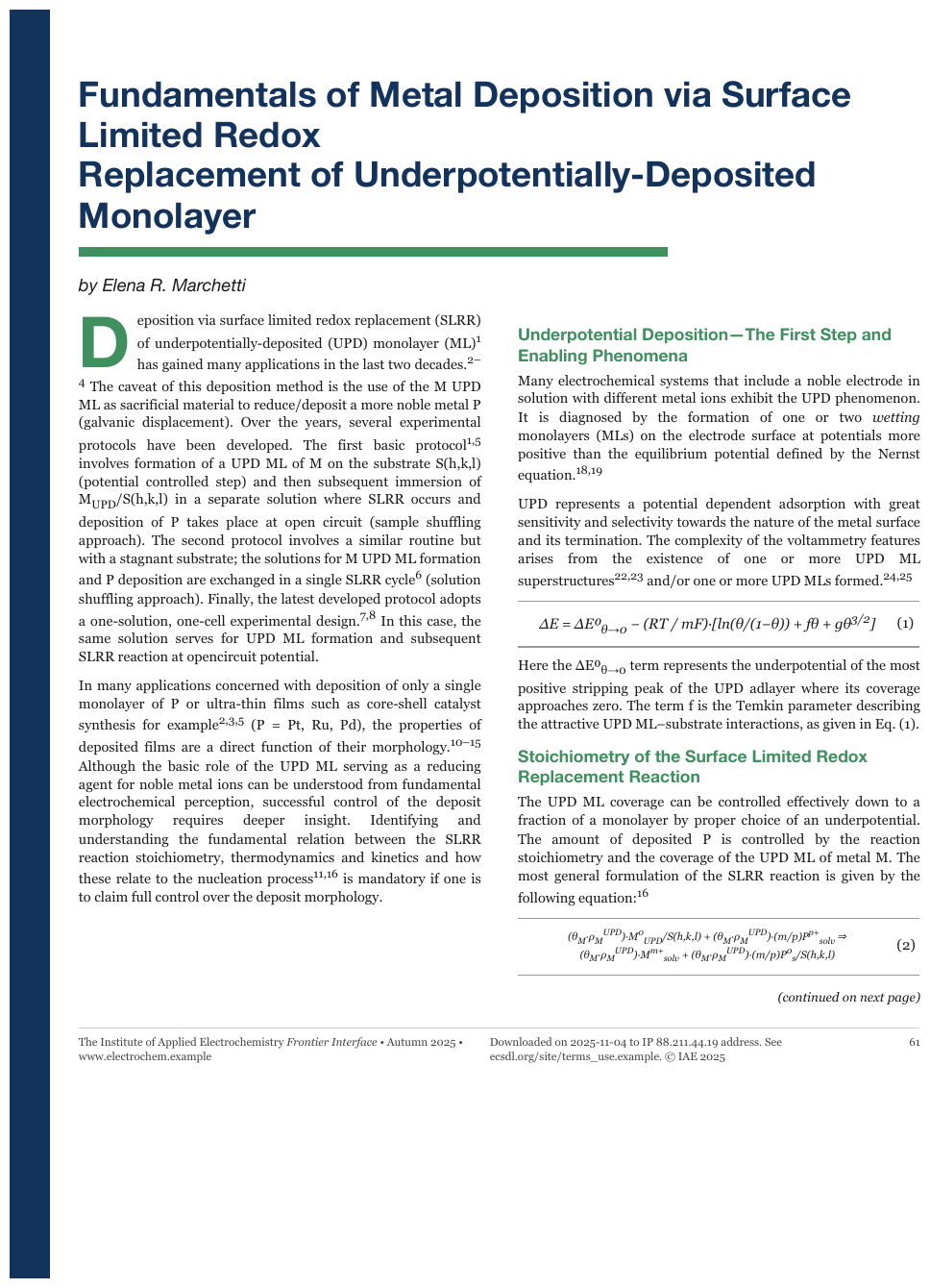
A four-line "D" opening "Deposition via surface limited redox replacement". The citation 2–4 is
split across two lines by the column; it is one superscript. The same page carries numbered display
equations — see Displayed Equations (§7.2.2).
Source page
Expected output · excerpt, first paragraph
Deposition via surface limited redox replacement (SLRR) of underpotentially-deposited (UPD) monolayer (ML)1 has gained many applications in the last two decades.2–4 The caveat of this deposition method is the use of the M UPD ML as sacrificial material to reduce/deposit a more noble metal P (galvanic displacement). Over the years, several experimental protocols have been developed. The first basic protocol1,5 involves formation of a UPD ML of M on the substrate S(h,k,l) (potential controlled step) and then subsequent immersion of MUPD/S(h,k,l) in a separate solution where SLRR occurs and deposition of P takes place at open circuit (sample shuffling approach).
…
Neighbouring rules, and how they differ
More
Sample sources1 +
Public-domain U.S. federal government source material.
- U.S. Coast Guard, "The Value of the Recreational Boating Safety Program" by Verne Gifford, Chief, Boating Safety Division, Proceedings Vol. 83 No. 1, p.7
Rule id text-drop-caps · text formatting inline