Escaping Printed Marks
The page prints an asterisk—will Markdown read it as syntax?
✅ NormativeSettled. The requirement holds as written.📄 Page ruleCan be applied from the page alone.Read §7.2.4 in the RFC ↗
A character the page prints is content, even when Markdown would read it as syntax. It MUST be
escaped so that it cannot open a span — \*\*, \_, \| — and it MUST NOT be deleted to avoid
the collision.
When it applies
Some marks a document prints are also Markdown's own punctuation: a menu that flags allergens with
**, a form that labels a field _____, a legal citation using |. The mark is transcribed, and
kept from being read as markup.
Melt-in-the-Middle Fish Pie Fishcake**      ← ** is a printed allergen marker
Beer-Battered Haddock & Chips§**               pointing at a legend elsewhere
Written unescaped, that ** opens a bold span that never closes and swallows the rest of the
block.
Reading the examples. Each one pairs a source page with the output the rule expects. ✅ Sample: the rule applies. ❌ Counter-sample: it looks like it applies and does not, or a rendering got it wrong. A non-conforming output, in red, is shown only for contrast. … marks content left out of an excerpt.
What to escape
| Printed | Output | Would otherwise |
| --- | --- | --- |
| * ** | \* \*\* | Open emphasis or bold |
| _ __ | \_ \__ | Open emphasis, or vanish inside a word |
| # at line start | \# | Become a heading |
| | inside a table cell | \| | Split the cell |
| ` | \` | Open a code span |
| ~~ | \~\~ | Strike the text through |
| --- at line start | \-\-\- | Become a horizontal rule, or collide with the page separator |
| A literal bracketed number or word — [1], [date] | \[1\], \[date\] | Read as a marker ([x], [blank]) or a form id |
| A literal angle-bracket placeholder — <NAME> | <NAME> | Be read as an HTML tag and vanish |
- Escaping SHOULD be applied only where the collision is real. A
*in the middle of a word, or a#mid-sentence, needs nothing. - A printed character MUST NOT be replaced by a different mark to avoid the collision: rewriting
**as<sup>2</sup>or as a word is the never invent failure, and dropping it is the never drop one. The marker is the only thing tying an item to its legend; a legend entry with nothing pointing at it is unusable.
A raised marker is still a superscript
Escaping decides how the character survives; it does not decide its position. A marker printed
above the baseline MUST be written <sup>\*\*</sup> — both rules apply, and neither substitutes
for the other. See Superscript and Subscript (§7.2.11).
Dashes, literal brackets and angle brackets
lines that open with three dashes
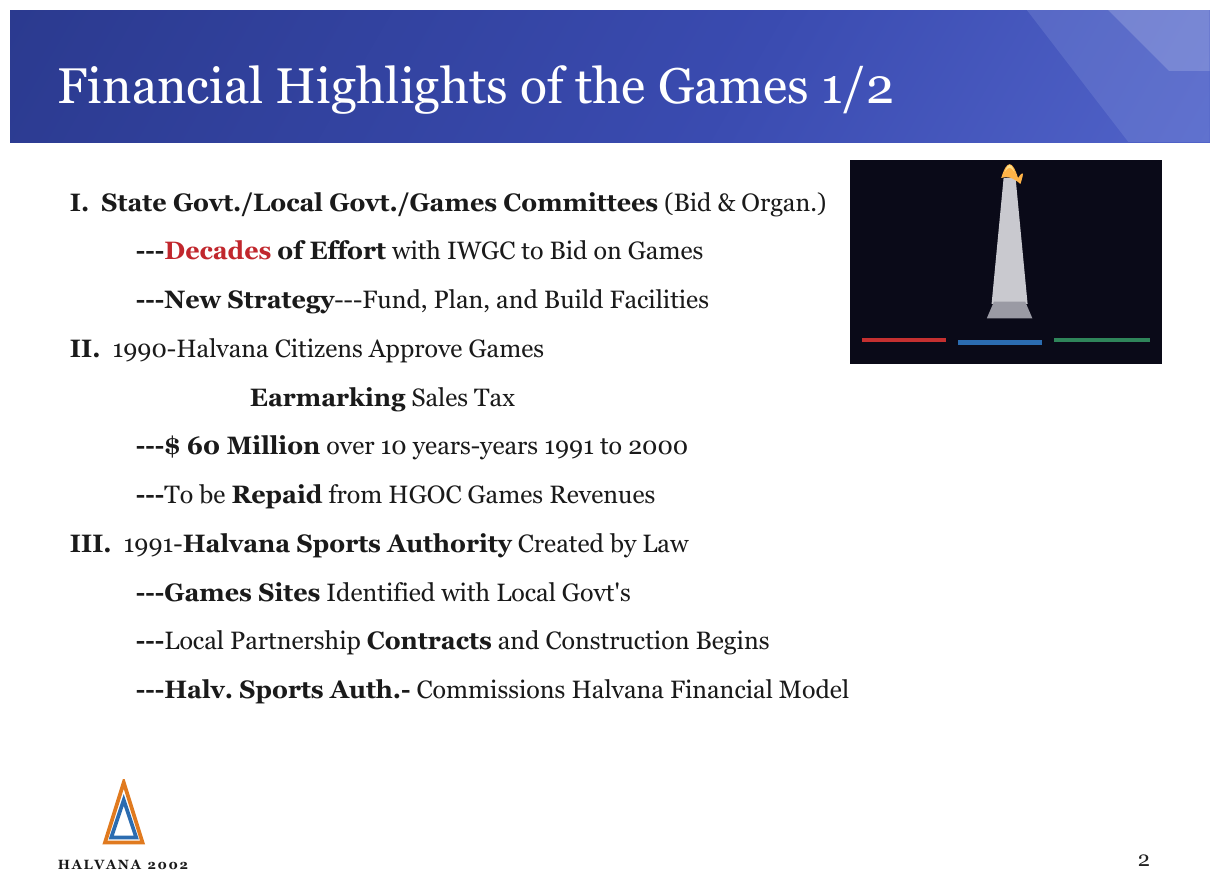
Every sub-point on the slide begins with --- as its marker, printed bold. Left as printed, each
line becomes a horizontal rule and its text vanishes into the rule above. The --- in the middle
of New Strategy---Fund is not at line start and needs no escape.
Source page
Expected output · slide body
Financial Highlights of the Games 1/2
I. State Govt./Local Govt./Games Committees (Bid & Organ.)
---Decades of Effort with IWGC to Bid on Games
---New Strategy---Fund, Plan, and Build Facilities
II. 1990-Halvana Citizens Approve Games
Earmarking Sales Tax
---$ 60 Million over 10 years-years 1991 to 2000
---To be Repaid from HGOC Games Revenues
III. 1991-Halvana Sports Authority Created by Law
---Games Sites Identified with Local Govt's
---Local Partnership Contracts and Construction Begins
---Halv. Sports Auth.- Commissions Halvana Financial Model
…
bracketed numbers that are not form ids
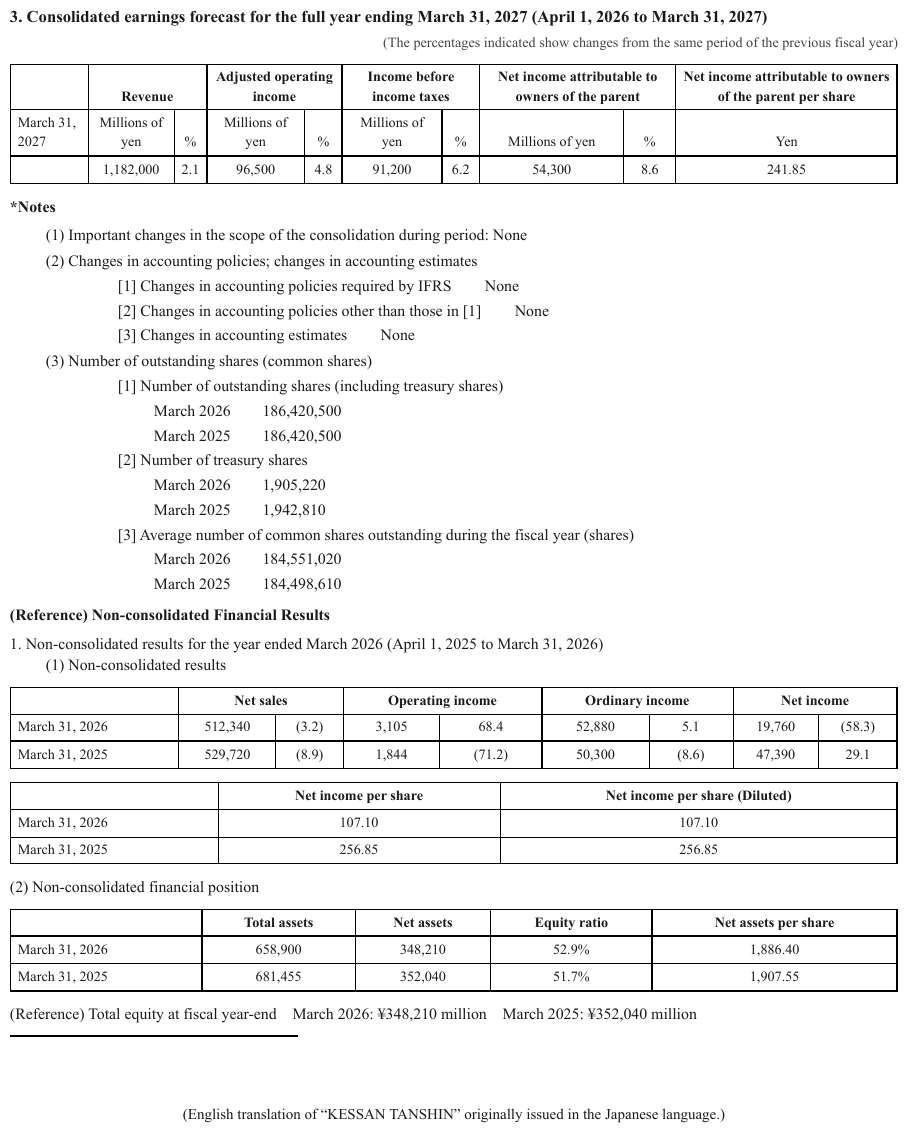
[1], [2], [3] number the sub-items of a note; the value None sits at the right. The same
page carries (1), (2), (3) for the items above them, which need no escape. The bold heading
*Notes opens with a printed asterisk.
Source page
Expected output · excerpt, the notes
*Notes
(1) Important changes in the scope of the consolidation during period: None
(2) Changes in accounting policies; changes in accounting estimates
[1] Changes in accounting policies required by IFRS None
[2] Changes in accounting policies other than those in [1] None
[3] Changes in accounting estimates None
(3) Number of outstanding shares (common shares)
[1] Number of outstanding shares (including treasury shares)
March 2026 186,420,500
March 2025 186,420,500
[2] Number of treasury shares
March 2026 1,905,220
March 2025 1,942,810
[3] Average number of common shares outstanding during the fiscal year (shares)
March 2026 184,551,020
March 2025 184,498,610
**\*Notes**

(1) Important changes in the scope of the consolidation during period: None

(2) Changes in accounting policies; changes in accounting estimates

[1] Changes in accounting policies required by IFRS None

[2] Changes in accounting policies other than those in [1] None

[3] Changes in accounting estimates None

(3) Number of outstanding shares (common shares)

[1] Number of outstanding shares (including treasury shares)

March 2026 186,420,500

March 2025 186,420,500

[2] Number of treasury shares

March 2026 1,905,220

March 2025 1,942,810

[3] Average number of common shares outstanding during the fiscal year (shares)

March 2026 184,551,020

March 2025 184,498,610bracketed template placeholders
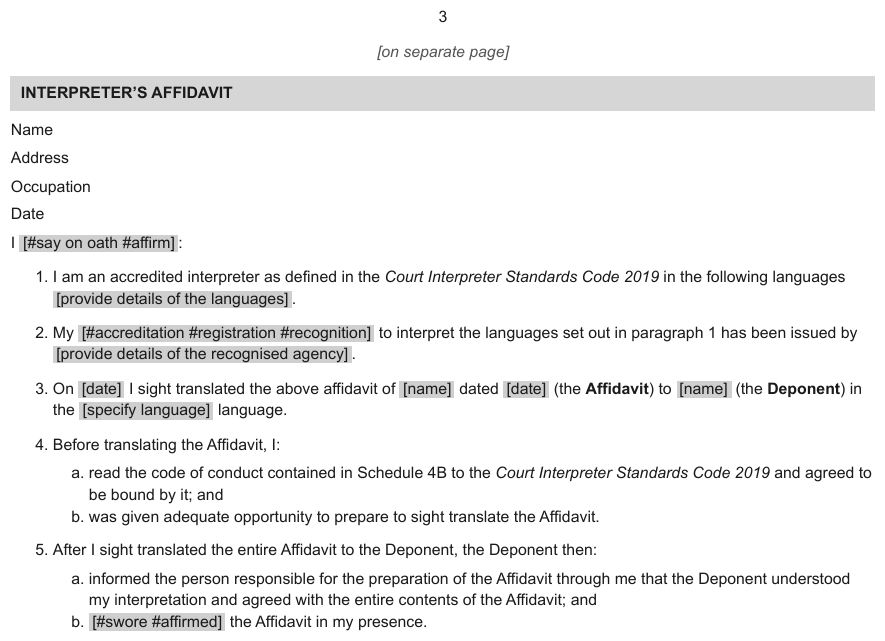
[#say on oath #affirm], [date], [name], [specify language] printed on grey highlights
inside the sentences of a court template. Every one would read as a form id or a checkbox, and the
grey is a highlight — see Highlighted Text (§7.2.5). The italic notice [on separate page] under the
page number is bracketed too.
Source page
Expected output · excerpt
3
[on separate page]
…
I [#say on oath #affirm]:
I am an accredited interpreter as defined in the Court Interpreter Standards Code 2019 in the following languages [provide details of the languages].
My [#accreditation #registration #recognition] to interpret the languages set out in paragraph 1 has been issued by [provide details of the recognised agency].
On [date] I sight translated the above affidavit of [name] dated [date] (the Affidavit) to [name] (the Deponent) in the [specify language] language.
Before translating the Affidavit, I:
a. read the code of conduct contained in Schedule 4B to the Court Interpreter Standards Code 2019 and agreed to be bound by it; and
b. was given adequate opportunity to prepare to sight translate the Affidavit.
After I sight translated the entire Affidavit to the Deponent, the Deponent then:
a. informed the person responsible for the preparation of the Affidavit through me that the Deponent understood my interpretation and agreed with the entire contents of the Affidavit; and
b. [#swore #affirmed] the Affidavit in my presence.
angle-bracket placeholders
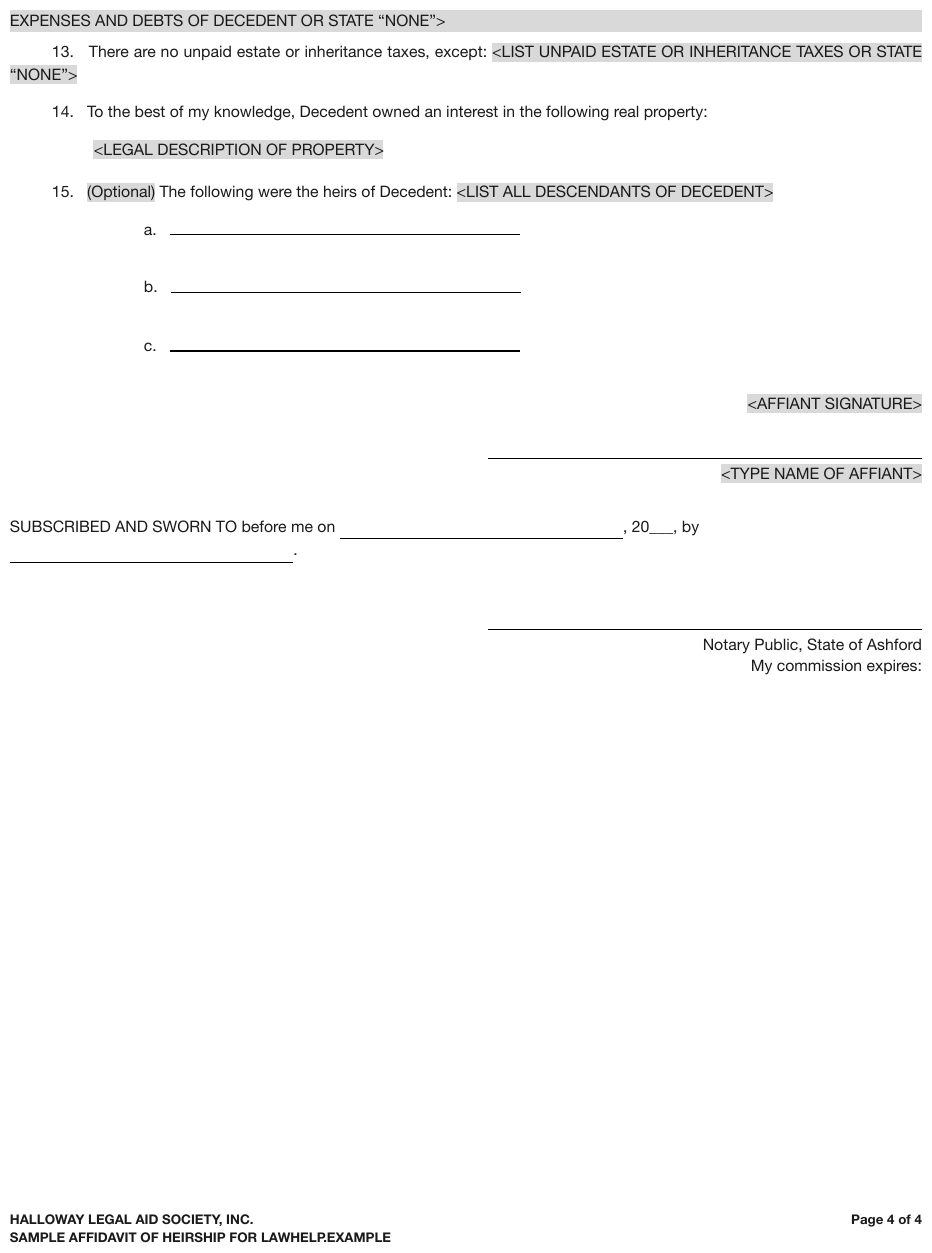
<LEGAL DESCRIPTION OF PROPERTY>, <AFFIANT SIGNATURE>, <TYPE NAME OF AFFIANT> on grey
highlights. Left as printed, each is an HTML tag and vanishes from a rendered page. The first line
is the tail of a placeholder that began on the previous page, so only its closing > is printed.
The ruled lines are empty fields — see Blanks Inside Sentences (§10.4.1).
Source page
Expected output · excerpt
EXPENSES AND DEBTS OF DECEDENT OR STATE “NONE”>
There are no unpaid estate or inheritance taxes, except: <LIST UNPAID ESTATE OR INHERITANCE TAXES OR STATE “NONE”>
To the best of my knowledge, Decedent owned an interest in the following real property:
<LEGAL DESCRIPTION OF PROPERTY>
(Optional) The following were the heirs of Decedent: <LIST ALL DESCENDANTS OF DECEDENT>
a. [blank]
b. [blank]
c. [blank]
<AFFIANT SIGNATURE>
[blank]
<TYPE NAME OF AFFIANT>
SUBSCRIBED AND SWORN TO before me on [blank], 20[blank], by [blank].
…
Neighbouring rules, and how they differ
More
Rule id text-escaping-printed-marks · text formatting inline