Horizontal Slicing
A wide table printed in stacked slices—re-widen it or keep the slices?
✅ NormativeSettled. The requirement holds as written.📄 Page ruleCan be applied from the page alone.Read §9.2.6 in the RFC ↗
A table too wide for the page, printed as stacked column blocks, MUST be rendered as one table per printed block, each keeping its repeated row-label column. The blocks MUST NOT be re-widened into a single wide table.
When it applies
A table too wide for the page is printed as column blocks stacked vertically, with the row-label column repeated in each block.
| State | Jan | Feb | Mar |
| AL    | 1.1 | 1.2 | 1.2 |

| State | Apr | May | Jun |   ← same rows, next columns
| AL    | 1.3 | 1.3 | 1.4 |
Reading the examples. Each one pairs a source page with the output the rule expects. ✅ Sample: the rule applies. ❌ Counter-sample: it looks like it applies and does not, or a rendering got it wrong. A non-conforming output, in red, is shown only for contrast. … marks content left out of an excerpt.
Examples
5line heaer
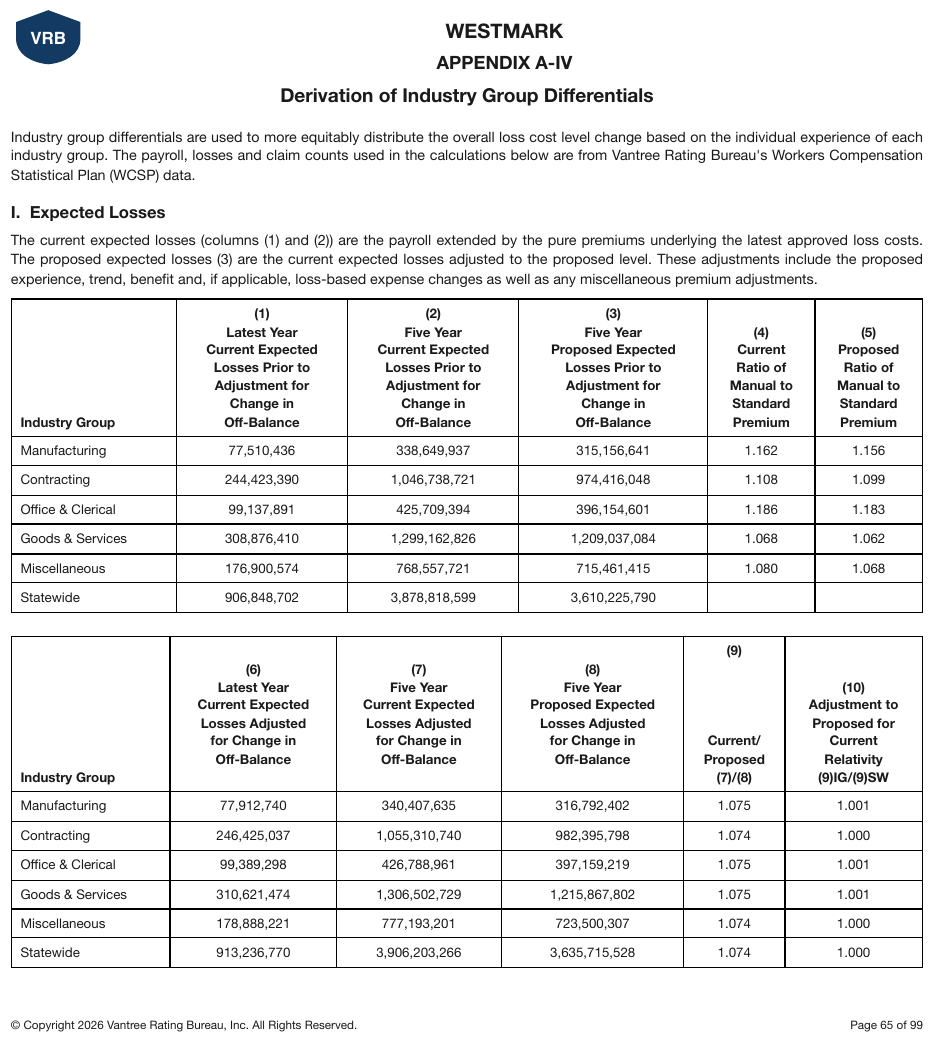
Columns (1)–(5) and (6)–(10) of one logical table stacked vertically, the Industry Group stub repeated in each block over the same six rows. Each column header is one label wrapped over many lines and is joined into one cell.
Source page
Expected output · both tables
| Industry Group | (1) Latest Year Current Expected Losses Prior to Adjustment for Change in Off-Balance | (2) Five Year Current Expected Losses Prior to Adjustment for Change in Off-Balance | (3) Five Year Proposed Expected Losses Prior to Adjustment for Change in Off-Balance | (4) Current Ratio of Manual to Standard Premium | (5) Proposed Ratio of Manual to Standard Premium |
|---|---|---|---|---|---|
| Manufacturing | 77,510,436 | 338,649,937 | 315,156,641 | 1.162 | 1.156 |
| Contracting | 244,423,390 | 1,046,738,721 | 974,416,048 | 1.108 | 1.099 |
| Office & Clerical | 99,137,891 | 425,709,394 | 396,154,601 | 1.186 | 1.183 |
| Goods & Services | 308,876,410 | 1,299,162,826 | 1,209,037,084 | 1.068 | 1.062 |
| Miscellaneous | 176,900,574 | 768,557,721 | 715,461,415 | 1.080 | 1.068 |
| Statewide | 906,848,702 | 3,878,818,599 | 3,610,225,790 |
| Industry Group | (6) Latest Year Current Expected Losses Adjusted for Change in Off-Balance | (7) Five Year Current Expected Losses Adjusted for Change in Off-Balance | (8) Five Year Proposed Expected Losses Adjusted for Change in Off-Balance | (9) Current/Proposed (7)/(8) | (10) Adjustment to Proposed for Current Relativity (9)IG/(9)SW |
|---|---|---|---|---|---|
| Manufacturing | 77,912,740 | 340,407,635 | 316,792,402 | 1.075 | 1.001 |
| Contracting | 246,425,037 | 1,055,310,740 | 982,395,798 | 1.074 | 1.000 |
| Office & Clerical | 99,389,298 | 426,788,961 | 397,159,219 | 1.075 | 1.001 |
| Goods & Services | 310,621,474 | 1,306,502,729 | 1,215,867,802 | 1.075 | 1.001 |
| Miscellaneous | 178,888,221 | 777,193,201 | 723,500,307 | 1.074 | 1.000 |
| Statewide | 913,236,770 | 3,906,203,266 | 3,635,715,528 | 1.074 | 1.000 |
A bus timetable too wide for the pagebusbands
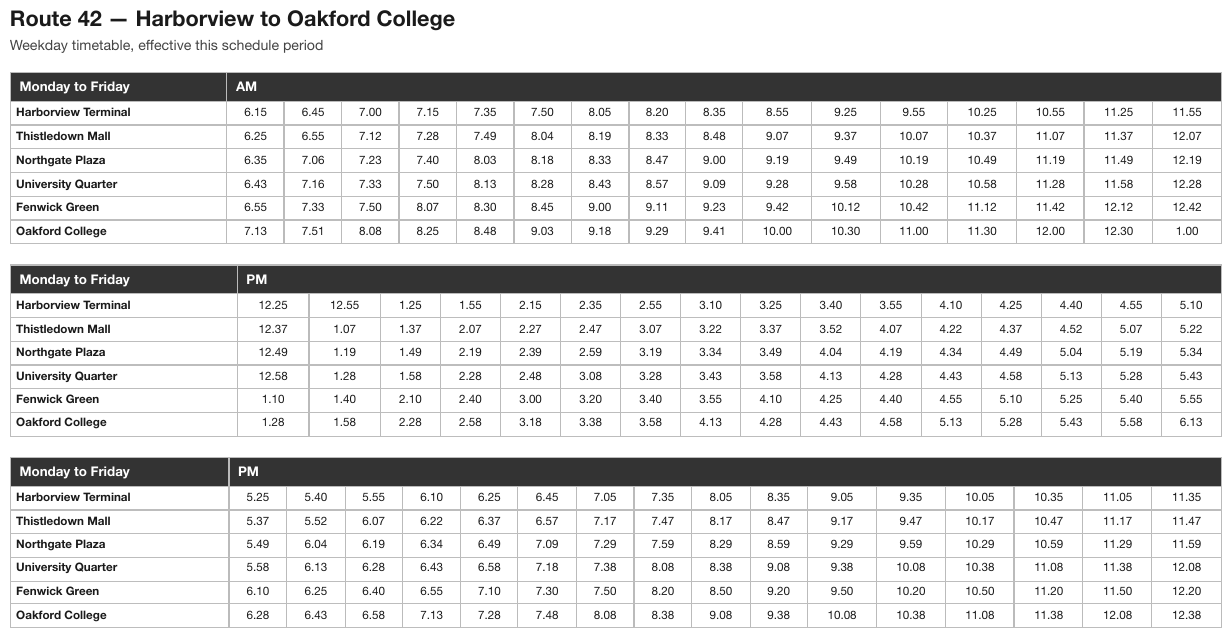
A bus timetable too wide for the page, printed as stacked AM/PM/PM blocks with the stop-name column repeated in every block. The stop names are bold.
Source page
Expected output · table 1 of 3
| Monday to Friday | AM | |||||||||||||||
|---|---|---|---|---|---|---|---|---|---|---|---|---|---|---|---|---|
| Harborview Terminal | 6.15 | 6.45 | 7.00 | 7.15 | 7.35 | 7.50 | 8.05 | 8.20 | 8.35 | 8.55 | 9.25 | 9.55 | 10.25 | 10.55 | 11.25 | 11.55 |
| Thistledown Mall | 6.25 | 6.55 | 7.12 | 7.28 | 7.49 | 8.04 | 8.19 | 8.33 | 8.48 | 9.07 | 9.37 | 10.07 | 10.37 | 11.07 | 11.37 | 12.07 |
| Northgate Plaza | 6.35 | 7.06 | 7.23 | 7.40 | 8.03 | 8.18 | 8.33 | 8.47 | 9.00 | 9.19 | 9.49 | 10.19 | 10.49 | 11.19 | 11.49 | 12.19 |
| University Quarter | 6.43 | 7.16 | 7.33 | 7.50 | 8.13 | 8.28 | 8.43 | 8.57 | 9.09 | 9.28 | 9.58 | 10.28 | 10.58 | 11.28 | 11.58 | 12.28 |
| Fenwick Green | 6.55 | 7.33 | 7.50 | 8.07 | 8.30 | 8.45 | 9.00 | 9.11 | 9.23 | 9.42 | 10.12 | 10.42 | 11.12 | 11.42 | 12.12 | 12.42 |
| Oakford College | 7.13 | 7.51 | 8.08 | 8.25 | 8.48 | 9.03 | 9.18 | 9.29 | 9.41 | 10.00 | 10.30 | 11.00 | 11.30 | 12.00 | 12.30 | 1.00 |
Requirements
- Each printed block MUST be rendered as its own table, top to bottom.
- The repeated row-label column MUST be kept in every block. It is printed in each one, and it is what makes the blocks joinable later.
- The blocks MUST NOT be re-widened into a single
State | Jan…Juntable, even though the repeated key makes the join look obvious.
How to recognise it
The blocks share their rows and differ in their columns — the same keys reappear down each block, with new column headers over them. That is the opposite of Column Continuation (§9.2.2), where the blocks share their columns and the key runs onward from one block to the next.
If the row keys do not line up across the blocks, it is not a slice of one wide table at all: the blocks are separate tables, with no join to look for.
The asymmetry worth noticing
In Column Continuation (§9.2.2), widening is the one shape that is always wrong: it pairs unrelated records with each other. Here it is the appealing option, because the repeated key column gives a reliable join and no record gets paired with a stranger. The rendering nevertheless stays one table per printed block: the page printed blocks, and the join is left to whoever consumes the output.
Look-alike
Two similar pages that call for different decisions. Synthetic, for teaching the boundary.
The same row labels repeat under a second block of columns. Re-widen it, or keep the blocks?
Horizontal slicing
| State | Jan | Feb |
|---|---|---|
| AL | 1.1 | 1.2 |
| AK | 0.9 | 1.0 |
| State | Mar | Apr |
|---|---|---|
| AL | 1.2 | 1.3 |
| AK | 1.0 | 1.1 |
One table per printed block. Never re-widen.
A genuinely wide table
| Non-Tobacco | Tobacco | |||
|---|---|---|---|---|
| Age | M | F | M | F |
| 35 | 1.02 | 0.98 | 1.61 | 1.44 |
| 45 | 1.31 | 1.20 | 2.08 | 1.83 |
One table, the super-headers spanning their columns.
Look at the structure. What evidence changes the answer?
Neighbouring rules, and how they differ
More
Rule id tables-horizontal-slicing · tables continuation boundaries