Transcript Pages
Q and A lines—a table, a paragraph, or one line each?
✅ NormativeSettled. The requirement holds as written.📄 Page ruleCan be applied from the page alone.Read §6.11 in the RFC ↗
On a transcript page, each speaker turn MUST be rendered as one paragraph that begins with its
printed marker (Q, A, THE COURT:), with its wrapped lines joined. Printed line numbers MUST
NOT appear in the Markdown; when line numbers are requested they are carried in the page's
line_numbers map, exactly as for Pleading Line Numbers (§5.8).
When it applies
A deposition or hearing transcript: numbered lines 1–25, a Q / A column, and text that wraps
to the left margin on its continuation lines. The line numbers are cited ("page 47, line 12"), so
the line structure is part of the content in a way ordinary prose is not.
 4    Q    Was ████████ paying that before?
 5    A    Yes, he was.
 6    Q    At the time of the temporary hearing, he was
 7  paying the car insurance?
Reading the examples. Each one pairs a source page with the output the rule expects. ✅ Sample: the rule applies. ❌ Counter-sample: it looks like it applies and does not, or a rendering got it wrong. A non-conforming output, in red, is shown only for contrast. … marks content left out of an excerpt.
Rendering
- Each speaker turn — a
Q, anA, or a colloquy line such asMR. HALE:orTHE COURT:— MUST be its own paragraph, separated from the next by a blank line. - The turn MUST begin with its speaker marker exactly as printed (
Q, notQ:), followed by its text. - A turn that wraps onto further printed lines MUST be joined into one paragraph: the continuation lines carry no marker on the page, and they carry none in the output.
- The printed line numbers MUST NOT appear in the Markdown, and the page MUST NOT be rendered as a
line | speaker | texttable.
Citing a line
Transcripts are cited by page and line ("page 83, line 13"). The citation is carried by the
line_numbers map defined in Pleading Line Numbers (§5.8): when line numbers are requested, each
printed number beside text gets an entry whose span covers that line's text inside its turn's
paragraph. A wrapped turn therefore keeps both of its line numbers even though it is one
paragraph.
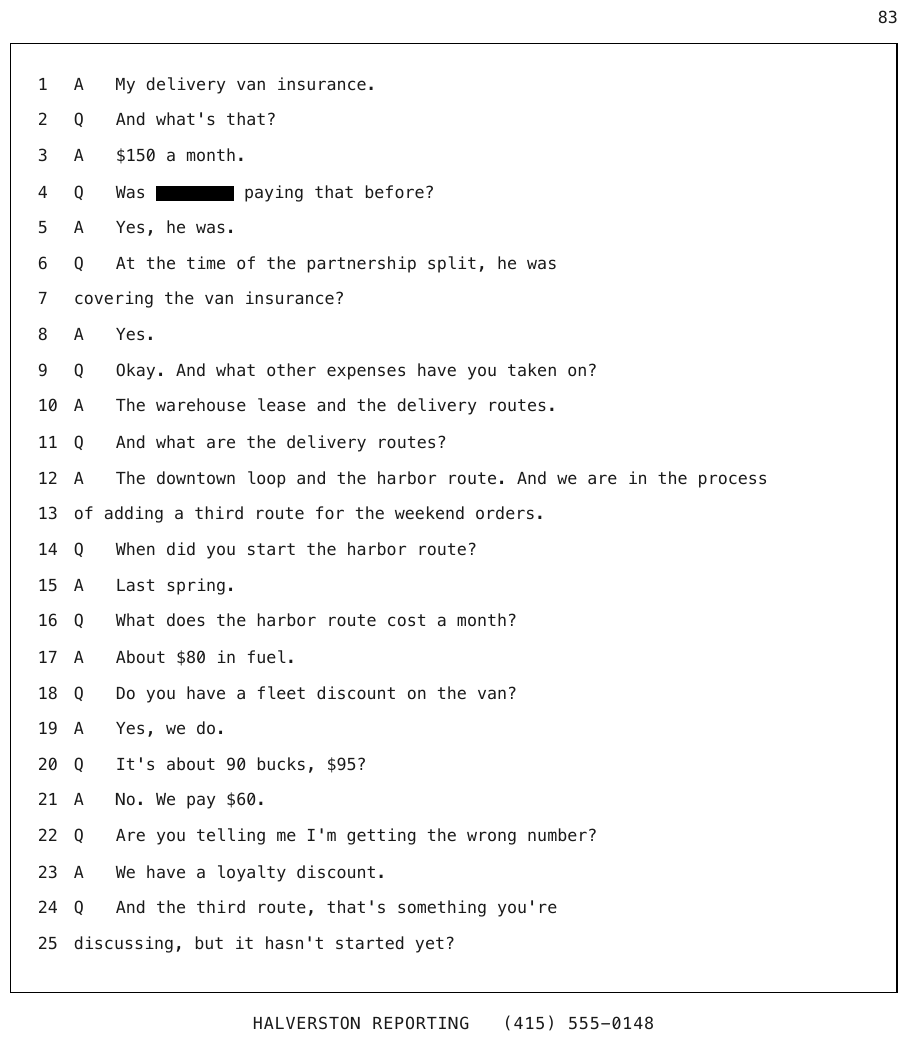
a deposition page
Twenty-five numbered lines in a ruled frame, Q and A in their own column, three turns wrapping
to the left margin (lines 6–7, 12–13 and 24–25), each joined into one paragraph, a black redaction bar inside line 4, the folio 83
above the frame and the reporting firm's name and telephone number as a footer.
Source page
Expected output
83
A My delivery van insurance.
Q And what's that?
A $150 a month.
Q Was [REDACTED] paying that before?
A Yes, he was.
Q At the time of the partnership split, he was covering the van insurance?
A Yes.
Q Okay. And what other expenses have you taken on?
A The warehouse lease and the delivery routes.
Q And what are the delivery routes?
A The downtown loop and the harbor route. And we are in the process of adding a third route for the weekend orders.
Q When did you start the harbor route?
A Last spring.
Q What does the harbor route cost a month?
A About $80 in fuel.
Q Do you have a fleet discount on the van?
A Yes, we do.
Q It's about 90 bucks, $95?
A No. We pay $60.
Q Are you telling me I'm getting the wrong number?
A We have a loyalty discount.
Q And the third route, that's something you're discussing, but it hasn't started yet?
HALVERSTON REPORTING (415) 555-0148
Neighbouring rules, and how they differ
More
Rule id layout-transcript-pages · layout structure legal line-numbers