Logos
A logo—describe the artwork or transcribe its words?
✅ NormativeSettled. The requirement holds as written.📄 Page ruleCan be applied from the page alone.Read §12.1.3 in the RFC ↗
A logo MUST be rendered as a marker carrying its printed words, [logo: OSTREVANE], at the logo's
place in reading order. A logo that prints no legible text MUST be rendered as [logo]. The
artwork MUST NOT be described.
When it applies
Almost every slide and letterhead carries one: a wordmark in the corner, a symbol beside it, sometimes a faint version behind the content. The marker keeps the printed words (never drop) and tells a reader that they are a brand mark rather than a word of the body text.
Reading the examples. Each one pairs a source page with the output the rule expects. ✅ Sample: the rule applies. ❌ Counter-sample: it looks like it applies and does not, or a rendering got it wrong. A non-conforming output, in red, is shown only for contrast. … marks content left out of an excerpt.
Requirements
- The words a logo prints MUST appear inside the marker exactly as printed, case included:
[logo: VELTRAND LIFE]. A wordmark set on two lines is one marker, its lines joined with a space. - The marker sits at the logo's place in reading order. A logo inside a header or footer band stays inside that band — see Recurring Page Furniture (§4.6).
- A logo with no legible text — a symbol on its own — is the bare
[logo]. - A symbol printed beside its own wordmark is part of that logo; it does not get a second marker.
- A faint copy of a mark repeated behind the content is not a second logo and adds nothing; it MUST NOT break into the table or paragraph it lies behind. A faint background mark that carries words is a watermark — see Watermarks (§7.3.13).
- The artwork — colours, shapes, the apple — MUST NOT be described.
a corner wordmark and a background mark
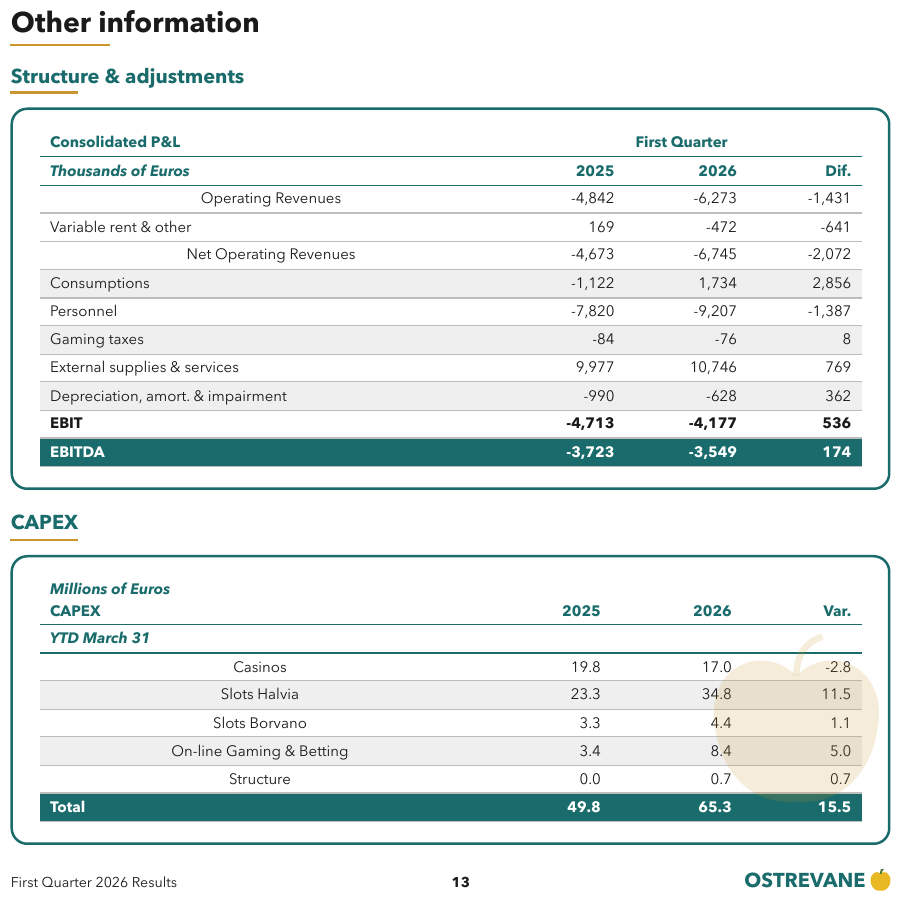
The wordmark OSTREVANE with a yellow apple symbol sits in the bottom-right corner of the footer
band, and a large faint version of the same apple sits behind the lower (CAPEX) table. The
background apple is a faint repeat of the mark and adds nothing to the table; the wordmark becomes
[logo: OSTREVANE] in the footer band. Expected boxes: the CAPEX table as one Table box; the footer band as page furniture,
with the wordmark inside it.
Source page
Expected output · CAPEX table and footer band
CAPEX
| Millions of Euros CAPEX | 2025 | 2026 | Var. |
|---|---|---|---|
| YTD March 31 | |||
| Casinos | 19.8 | 17.0 | -2.8 |
| Slots Halvia | 23.3 | 34.8 | 11.5 |
| Slots Borvano | 3.3 | 4.4 | 1.1 |
| On-line Gaming & Betting | 3.4 | 8.4 | 5.0 |
| Structure | 0.0 | 0.7 | 0.7 |
| Total | 49.8 | 65.3 | 15.5 |
First Quarter 2026 Results 13 [logo: OSTREVANE]
two stacked wordmarks on a slide
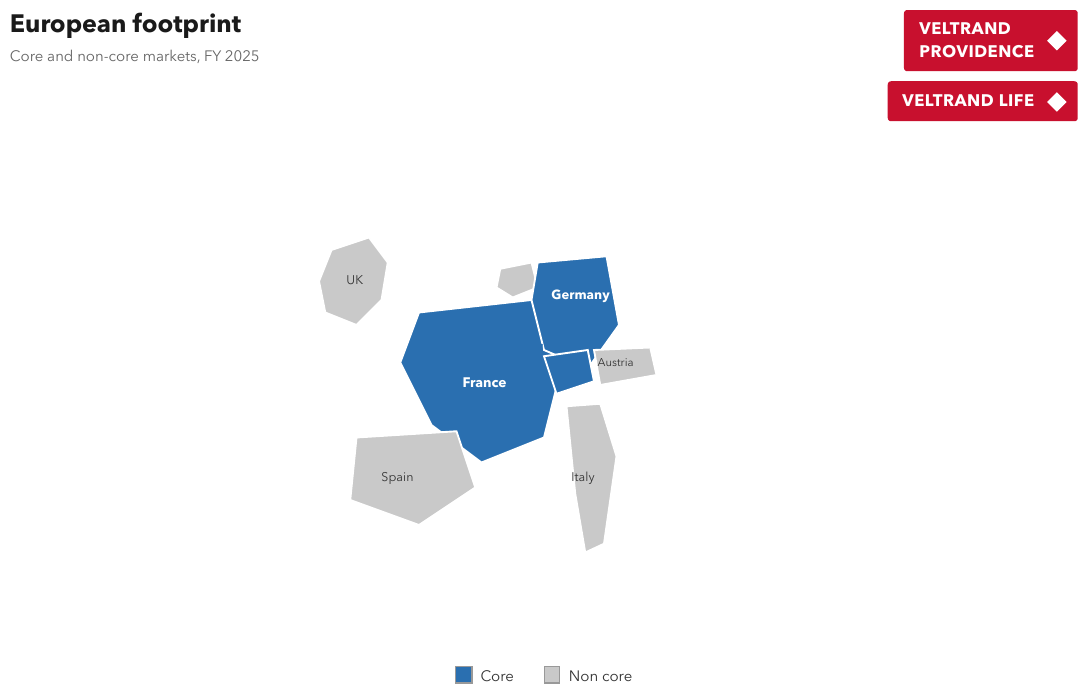
VELTRAND PROVIDENCE (set on two lines) and VELTRAND LIFE, each a red box with a white diamond
symbol, top-right. Each wordmark is one marker; the two-line one joins its lines with a space.
The slide's map is a real map with a two-entry legend — see Geographic Maps (§12.2.4); it is elided
here. Expected boxes: one box per wordmark.
Source page
Expected output · title and wordmarks
European footprint
Core and non-core markets, FY 2025
[logo: VELTRAND PROVIDENCE]
[logo: VELTRAND LIFE]
…
# European footprint

Core and non-core markets, FY 2025

[logo: VELTRAND PROVIDENCE]

[logo: VELTRAND LIFE]

<!-- … -->Neighbouring rules, and how they differ
More
Rule id images-logos · images furniture