Run-In Headings
A bold label that starts a sentence—a heading or part of the paragraph?
✅ NormativeSettled. The requirement holds as written.📄 Page ruleCan be applied from the page alone.Read §6.8 in the RFC ↗
A run-in label and the sentence, value or URL that follows it on the same line MUST be rendered as one paragraph, with the label's printed emphasis preserved. The label MUST NOT be rendered as a Markdown heading.
When it applies
A run-in heading is set at the start of its own paragraph, in bold or colour, with the body text continuing on the same line. Contracts number their clauses this way; glossaries print the term this way.
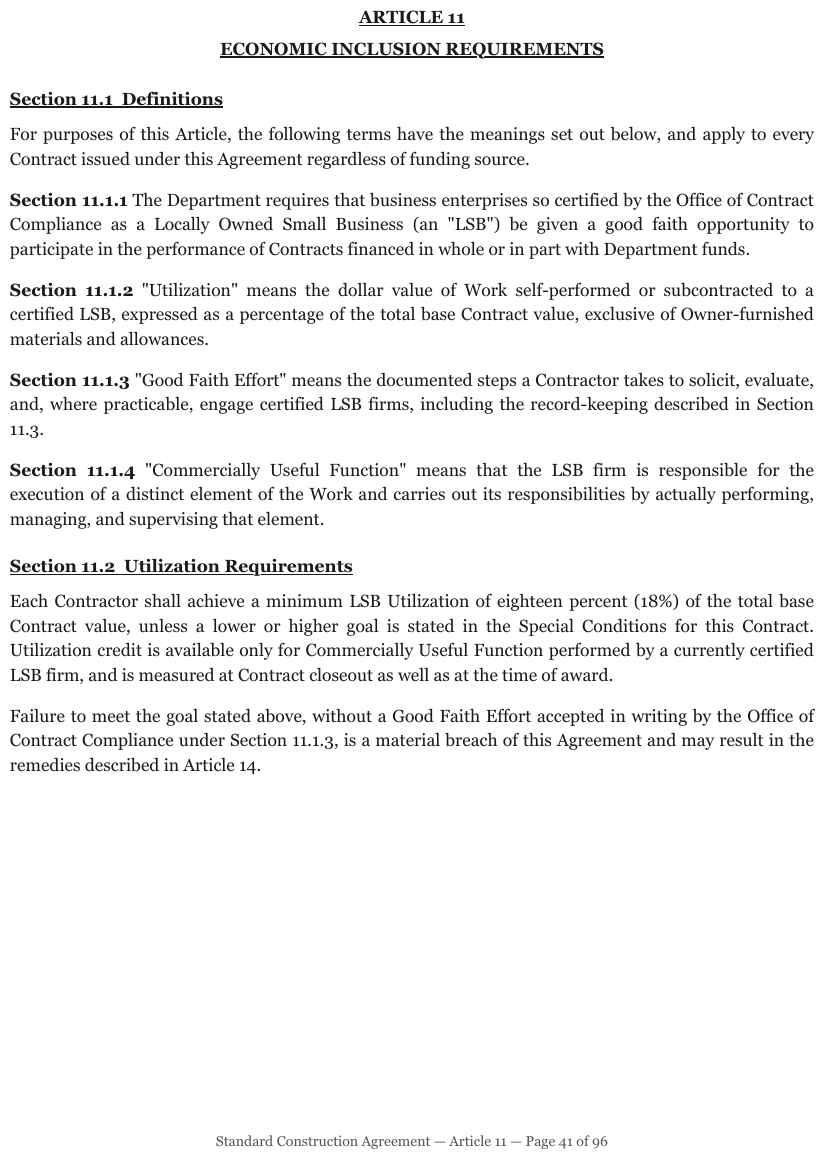
Section 11.1.1 The Department requires that business enterprises so certified by …
AMBIGUOUS  Confusing question in that it is capable of being understood in more than one sense.
  ↑ bold label, text continues on the same line
Reading the examples. Each one pairs a source page with the output the rule expects. ✅ Sample: the rule applies. ❌ Counter-sample: it looks like it applies and does not, or a rendering got it wrong. A non-conforming output, in red, is shown only for contrast. … marks content left out of an excerpt.
Requirements
- The label and its text MUST stay in one paragraph; a label that wraps onto a further line remains part of the same paragraph.
- The label's printed bold, italic, underline or small capitals MUST be kept as inline marks (see Bold and Italics (§7.2.1), Underlined Text (§7.2.12), Small Capitals (§7.2.10)).
- The label MUST NOT be split onto a line of its own or promoted to a heading: a lead-in rendered as a heading creates a false outline entry.
- A numbered title set on its own line, with its text beneath, is not run-in; it is a heading — see Numbered Section Headings (§6.5).
numbered contract clauses
Section 11.1.1 through 11.1.4 open their paragraphs in bold; Section 11.1 and 11.2 are set
on their own lines, underlined, and behave as ordinary headings. Both shapes on one page. The
two-line ARTICLE 11 title is one heading (see Stacked Headings (§6.9)). Heading depths are relative:
the page, sheet 41 of 96, does not show the outline above the article.
Source page
Expected output
ARTICLE 11 ECONOMIC INCLUSION REQUIREMENTS
Section 11.1 Definitions
For purposes of this Article, the following terms have the meanings set out below, and apply to every Contract issued under this Agreement regardless of funding source.
Section 11.1.1 The Department requires that business enterprises so certified by the Office of Contract Compliance as a Locally Owned Small Business (an "LSB") be given a good faith opportunity to participate in the performance of Contracts financed in whole or in part with Department funds.
Section 11.1.2 "Utilization" means the dollar value of Work self-performed or subcontracted to a certified LSB, expressed as a percentage of the total base Contract value, exclusive of Owner-furnished materials and allowances.
Section 11.1.3 "Good Faith Effort" means the documented steps a Contractor takes to solicit, evaluate, and, where practicable, engage certified LSB firms, including the record-keeping described in Section 11.3.
Section 11.1.4 "Commercially Useful Function" means that the LSB firm is responsible for the execution of a distinct element of the Work and carries out its responsibilities by actually performing, managing, and supervising that element.
Section 11.2 Utilization Requirements
Each Contractor shall achieve a minimum LSB Utilization of eighteen percent (18%) of the total base Contract value, unless a lower or higher goal is stated in the Special Conditions for this Contract. Utilization credit is available only for Commercially Useful Function performed by a currently certified LSB firm, and is measured at Contract closeout as well as at the time of award.
Failure to meet the goal stated above, without a Good Faith Effort accepted in writing by the Office of Contract Compliance under Section 11.1.3, is a material breach of this Agreement and may result in the remedies described in Article 14.
Standard Construction Agreement — Article 11 — Page 41 of 96
a glossary of objections
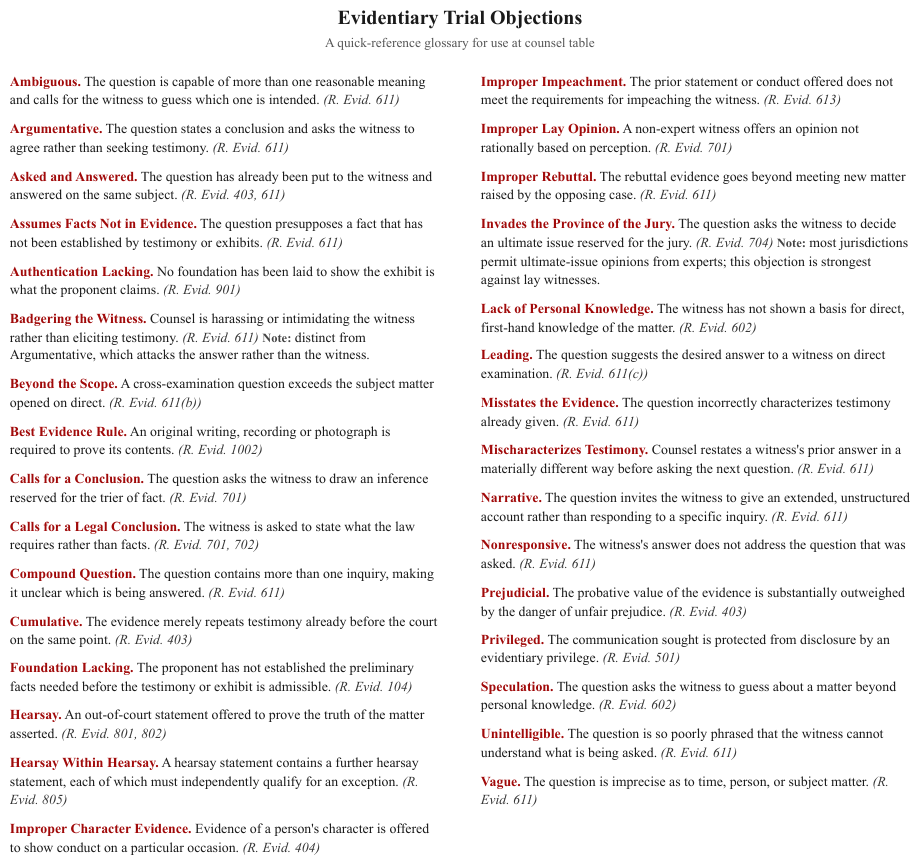
Thirty-odd entries, each a red bold term followed on the same line by its definition and a rule
citation. Two entries carry a bold Note: inside the definition. The red is decoration and is not
carried; the italic citations are. The left column is read before the right.
Source page
Expected output · excerpt
Evidentiary Trial Objections
A quick-reference glossary for use at counsel table
Ambiguous. The question is capable of more than one reasonable meaning and calls for the witness to guess which one is intended. (R. Evid. 611)
Argumentative. The question states a conclusion and asks the witness to agree rather than seeking testimony. (R. Evid. 611)
…
Badgering the Witness. Counsel is harassing or intimidating the witness rather than eliciting testimony. (R. Evid. 611) Note: distinct from Argumentative, which attacks the answer rather than the witness.
…
Invades the Province of the Jury. The question asks the witness to decide an ultimate issue reserved for the jury. (R. Evid. 704) Note: most jurisdictions permit ultimate-issue opinions from experts; this objection is strongest against lay witnesses.
…
section numbers in the margin
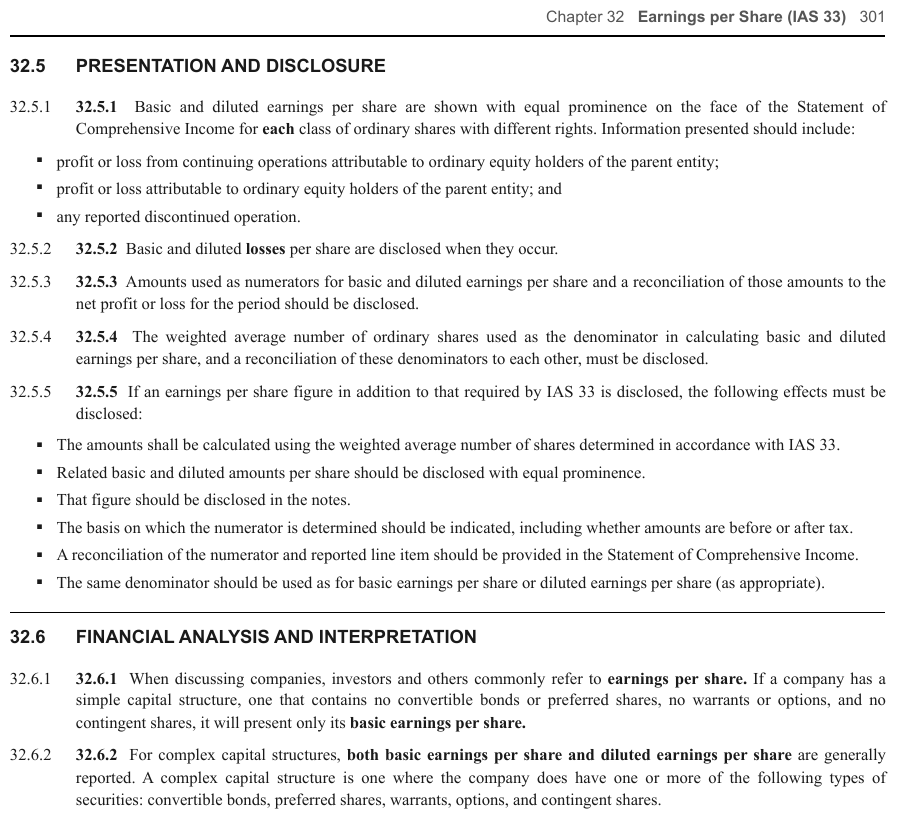
32.5 and 32.6 sit in a left margin column beside their headings; 32.5.1 … 32.6.2 open
their paragraphs in bold on the same line. The page also prints each paragraph number a second
time, in plain type, in the margin column; both copies are printed, so both are kept, in reading
order. Heading depths follow the numbering and assume chapters are top level; the running header
is left out of this excerpt.
Source page
Expected output · excerpt
32.5 PRESENTATION AND DISCLOSURE
32.5.1 32.5.1 Basic and diluted earnings per share are shown with equal prominence on the face of the Statement of Comprehensive Income for each class of ordinary shares with different rights. Information presented should include:
- profit or loss from continuing operations attributable to ordinary equity holders of the parent entity;
- profit or loss attributable to ordinary equity holders of the parent entity; and
- any reported discontinued operation.
32.5.2 32.5.2 Basic and diluted losses per share are disclosed when they occur.
…
32.6 FINANCIAL ANALYSIS AND INTERPRETATION
32.6.1 32.6.1 When discussing companies, investors and others commonly refer to earnings per share. If a company has a simple capital structure, one that contains no convertible bonds or preferred shares, no warrants or options, and no contingent shares, it will present only its basic earnings per share.
…
Labels followed by values
A label followed on the same line by a value or URL MUST be kept as a label–value pair in one paragraph. Small caps, colour or underlining do not make it a heading. See Recognising Ambiguous Headings (§6.7).
Look-alike
Two similar pages that call for different decisions. Synthetic, for teaching the boundary.
A bold label opens a line. Heading, or part of the paragraph?
A run-in heading
One paragraph, the label bold inline.
A standalone heading
A heading, at its document-relative depth.
Look at the structure. What evidence changes the answer?
Neighbouring rules, and how they differ
More
Rule id headings-run-in-headings · rule structure headings