Continued in the Title
"(continued)" in a title—printed text or noise?
✅ NormativeSettled. The requirement holds as written.📄 Page ruleCan be applied from the page alone.Read §9.2.3 in the RFC ↗
A continuation marker — (cont'd), (continued), Table 5 — … (cont.) — is printed text and MUST
be kept verbatim in the title. The fragment on this page MUST be rendered as a table in its own
right.
When it applies
Table 5 — Lapse Rates (cont'd)     ← explicit continuation marker
| Duration | Rate |
Reading the examples. Each one pairs a source page with the output the rule expects. ✅ Sample: the rule applies. ❌ Counter-sample: it looks like it applies and does not, or a rendering got it wrong. A non-conforming output, in red, is shown only for contrast. … marks content left out of an excerpt.
Requirements
- The title MUST be transcribed exactly as printed, marker included. The marker MUST NOT be stripped to tidy the title, nor rewritten into a fuller form.
- The table on this page MUST be rendered as a table in its own right. Its rows MUST NOT be fused with a fragment on a previous page (unless the join option of Output Options (§3.5) was requested).
- The kept marker is what records that the fragment continues an earlier table. It is the strongest continuation evidence a page can give — far stronger than the indirect signals other fragments offer.
Why this is the easy end of a hard problem
Everywhere else in Cross-Page Tables (§4.3), continuation has to be inferred from weak signals: a missing header, a first row that starts mid-key, rows running right to the page edge. Here the document says it outright, so there is nothing to infer — only a statement not to throw away.
Keeping the marker settles the fidelity half of the question however the fragments are eventually joined: the words are printed on the page, so they survive (never drop). The fragment stays on its own page and is flagged as continued — see Cross-Page Tables (§4.3).
a band that says Cont'd
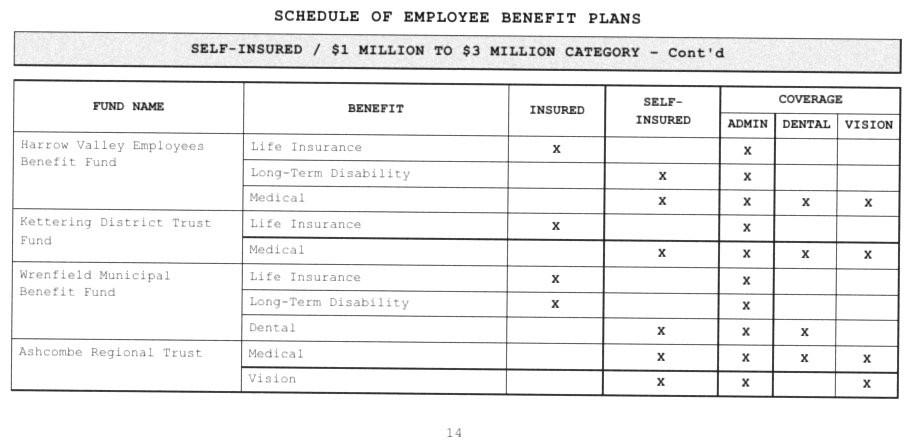
SELF-INSURED / $1 MILLION TO $3 MILLION CATEGORY – Cont'd as a band under the heading of a
scanned schedule. It is boxed on its own, apart from the table frame, so it is a title above the
table, kept with its marker. Each fund spans several printed lines, one benefit per line, with X
marks in the INSURED, SELF-INSURED and three COVERAGE columns; the fund-name cell is one merged
cell beside its benefit rows.
Source page
Expected output
SCHEDULE OF EMPLOYEE BENEFIT PLANS
| FUND NAME | BENEFIT | INSURED | SELF-INSURED | COVERAGE | ||
|---|---|---|---|---|---|---|
| ADMIN | DENTAL | VISION | ||||
| Harrow Valley Employees Benefit Fund | Life Insurance | X | X | |||
| Long-Term Disability | X | X | ||||
| Medical | X | X | X | X | ||
| Kettering District Trust Fund | Life Insurance | X | X | |||
| Medical | X | X | X | X | ||
| Wrenfield Municipal Benefit Fund | Life Insurance | X | X | |||
| Long-Term Disability | X | X | ||||
| Dental | X | X | X | |||
| Ashcombe Regional Trust | Medical | X | X | X | X | |
| Vision | X | X | X | |||
—Continued in a table title
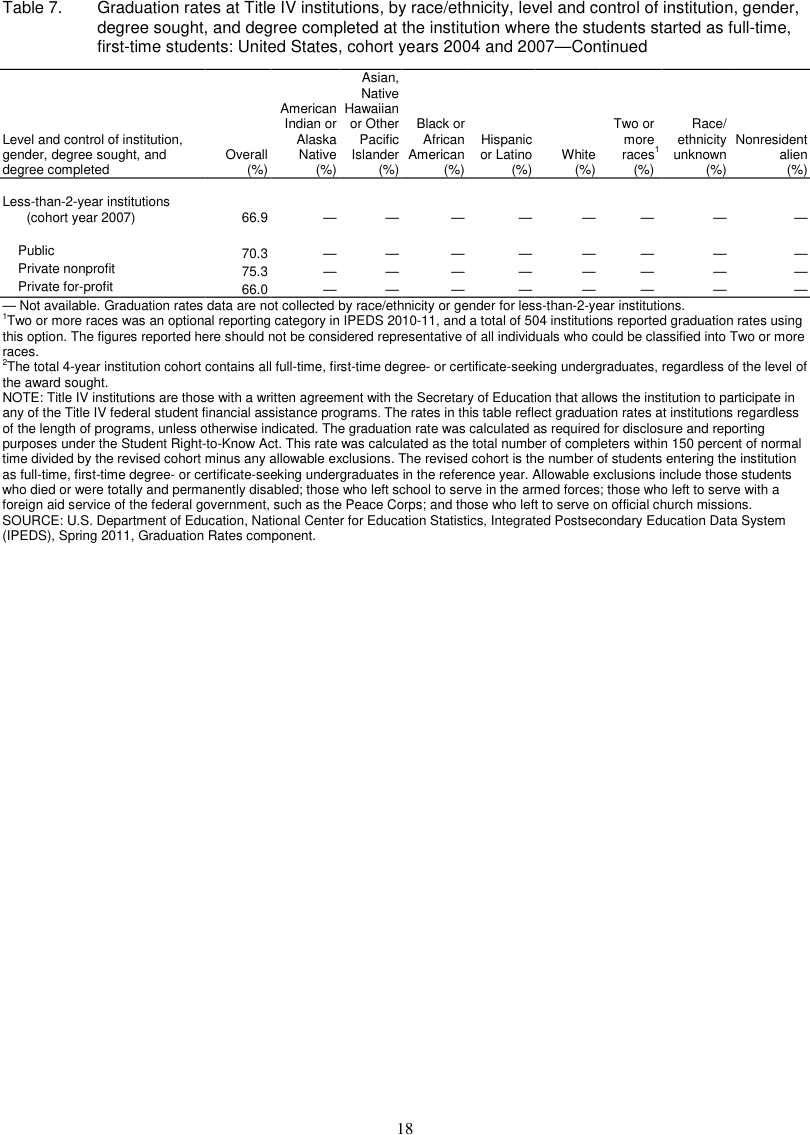
Table 7. Graduation rates … cohort years 2004 and 2007—Continued over the last four rows of a
table, with the full header stack repeated and a — Not available legend below. Every column
header is one label wrapped over several lines; Public and the two private rows are indented under
the first row.
Source page
Source: U.S. Department of Education, National Center for Education Statistics (NCES), Integrated Postsecondary Education Data System (IPEDS), Table 7 (public domain)
Expected output · excerpt, the title and the table
| Level and control of institution, gender, degree sought, and degree completed | Overall (%) | American Indian or Alaska Native (%) | Asian, Native Hawaiian or Other Pacific Islander (%) | Black or African American (%) | Hispanic or Latino (%) | White (%) | Two or more races1 (%) | Race/ethnicity unknown (%) | Nonresident alien (%) |
|---|---|---|---|---|---|---|---|---|---|
| Less-than-2-year institutions (cohort year 2007) | 66.9 | — | — | — | — | — | — | — | — |
| Public | 70.3 | — | — | — | — | — | — | — | — |
| Private nonprofit | 75.3 | — | — | — | — | — | — | — | — |
| Private for-profit | 66.0 | — | — | — | — | — | — | — | — |
— Not available. Graduation rates data are not collected by race/ethnicity or gender for less-than-2-year institutions.
…
Neighbouring rules, and how they differ
More
Sample sources1 +
Public-domain U.S. federal government source material.
- U.S. Department of Education, National Center for Education Statistics (NCES), Integrated Postsecondary Education Data System (IPEDS), Table 7
Rule id tables-continued-in-the-title · tables continuation captions