Conformance
What does an output have to satisfy to conform?
✅ NormativeSettled. The requirement holds as written.📚 Document ruleNeeds other pages of the same document; decided once and applied on every page.Read §1.2 in the RFC ↗
A conforming output is a Markdown rendering of a document that satisfies every MUST of this protocol, optionally accompanied by a sidecar that satisfies The Sidecar (§3.4). A producer conforms when every output it emits conforms.
Reading the examples. Each one pairs a source page with the output the rule expects. ✅ Sample: the rule applies. ❌ Counter-sample: it looks like it applies and does not, or a rendering got it wrong. A non-conforming output, in red, is shown only for contrast. … marks content left out of an excerpt.
The point, in a small example
One requirement, two verdicts. Each non-conforming output fails a MUST, so that output does not conform. The expected output passes this requirement; whole-document conformance still needs every other MUST. These pages are made up to isolate the rule.
Text inside an image is still text
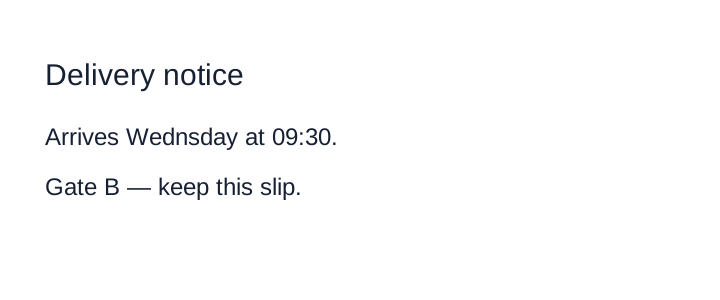
Transcribe all visible text, including the printed typo “Wednsday”. Do not substitute an image link, a summary or a corrected spelling. The top line is a notice label, not a document section.
Source page
Non-conforming output
What the rule rules out.
Expected output
Delivery notice

Arrives Wednsday at 09:30.

Gate B — keep this slip.A pictured table stays a table
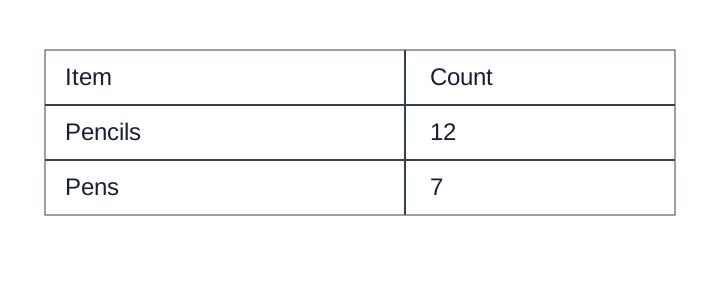
The image contains a two-column table. Preserve both rows and the printed headers; a prose summary loses the cell relationships.
Source page
Non-conforming output
What the rule rules out.
A table listing stationery supplies.Expected output
<table>
<tr><th>Item</th><th>Count</th></tr>
<tr><td>Pencils</td><td>12</td></tr>
<tr><td>Pens</td><td>7</td></tr>
</table>What is judged
An output is judged against the document as rendered — the pages a reader sees — and never against the file's text layer, OCR, or another output. See The Page Is the Ground Truth (§2.1).
| Part | Required | Governed by |
|---|---|---|
| Markdown | always | Markdown Rendering (§3.2) and chapters 4–13 |
| Sidecar | when boxes are requested | The Sidecar (§3.4), Boxes and Granularity (§3.3) |
Verdicts
A check of an output against the protocol yields findings, each tied to one requirement:
- a violated MUST is an error; any error makes the output non-conforming;
- a violated SHOULD is a warning; warnings do not affect conformance;
- a requirement marked ❓ open yields warnings only, whatever its keyword, until it is settled.
Equivalent forms
Where the protocol accepts more than one rendering (⚖️), every accepted rendering conforms, and a consumer MUST treat them as equal. A document MUST NOT mix accepted renderings of the same situation — see Choices Made Once Per Document (§4.2) and Accepted Alternatives (§A.1).
Output options
A few requirements depend on what the producer was asked to produce, such as whether table fragments are joined across pages. They are listed in Output Options (§3.5); an output is judged under the options it was produced with.
Neighbouring rules, and how they differ
More
Rule id conventions-conformance · conventions