Block Classes
A region could be two things—which class does it get?
✅ NormativeSettled. The requirement holds as written.📄 Page ruleCan be applied from the page alone.Read §5.3 in the RFC ↗
Every element MUST have exactly one of the seventeen classes below. Its layout class MUST match the class of the corresponding Markdown element defined in Elements (§3.1). A class MUST NOT be chosen merely to complete a page: where the class is genuinely unclear, the output MUST NOT assert a class the page does not support.
Reading the examples. Each one pairs a source page with the output the rule expects. ✅ Sample: the rule applies. ❌ Counter-sample: it looks like it applies and does not, or a rendering got it wrong. A non-conforming output, in red, is shown only for contrast. … marks content left out of an excerpt.
The seventeen classes
| Class | Used for |
|---|---|
| Text | One coherent paragraph or prose block |
| Title | The overall document title, on its title or front page |
| Section-header | A separate heading introducing a section or subsection |
| List-item | One marked or hanging list item, including its continuation lines |
| Caption | Text outside normal flow that names or explains a table, picture or formula |
| Footnote | A footnote, source note, method note, or small explanatory note tied to the body |
| Page-header | Repeated or page-specific content in the top margin |
| Page-footer | Bottom-margin content — a page number alone qualifies |
| Picture | A unified photo, diagram, chart, logo, map or molecular structure |
| Table | A ruled or borderless row-and-column structure whose alignment matters |
| Formula | A standalone displayed expression, including its displayed equation number |
| Checkbox-Selected | A selected checkbox mark only — not its label |
| Checkbox-Unselected | An unselected checkbox mark only — not its label |
| Code | Preformatted source, commands, logs, or fixed-width output |
| Document Index | A table of contents, index, or directory-like navigation block |
| Form | Irregular controls or fields arranged for data entry |
| Key-Value Region | A compact label/value group without a regular table grid |
How each class is rendered in Markdown is set out in Elements (§3.1).
One class across layout and Markdown
The layout box and the corresponding Markdown represent the same element and MUST use the same class. A producer MUST resolve a disagreement using the printed content and update both representations to agree. A detected label is only a suggestion — see Layout Regions (§5.7).
The class describes the element's role; Markdown syntax alone does not determine it. Text and
Footnote both render as paragraphs while keeping their distinct classes. A table or chart Caption
uses <caption> inside its object's table HTML and keeps its own Caption class and layout box. A Picture
rendered as <table data-source="chart"> keeps the Picture class; a printed Table has the Table class. The
renderings prescribed in Elements (§3.1) govern these cases.
The distinctions that decide most cases
| Table vs Form | A Table has a regular row-column structure. A Form has irregular fields or controls for data entry. |
| Table vs Key-Value Region | A Table repeats rows and columns. A Key-Value Region is a compact label/value group with no regular grid. |
| Title vs Section-header | Title is only the document's overall title on its cover — which sheet that is, is decided once in Document Type (§4.4). A repeated title on a later page is Text or page furniture. |
| Caption vs Text | Proximity is not enough. A Caption names or explains an object and sits outside normal flow. Ordinary nearby prose is Text. |
| Caption vs Footnote | A Caption identifies an object. A Footnote adds a source, method, qualification or note. |
| Picture vs Formula | A complex chemical structure is a Picture. An ordinary standalone mathematical expression is a Formula. |
| Checkbox | The box covers only the square, circle or check mark — never its label. |
The diagrams below are synthetic pages shown with their element overlays, one colour per class. There is no diagram yet for Checkbox-Selected, Checkbox-Unselected, Code, Document Index, Form or Key-Value Region; the definitions above govern those.
Title and Text
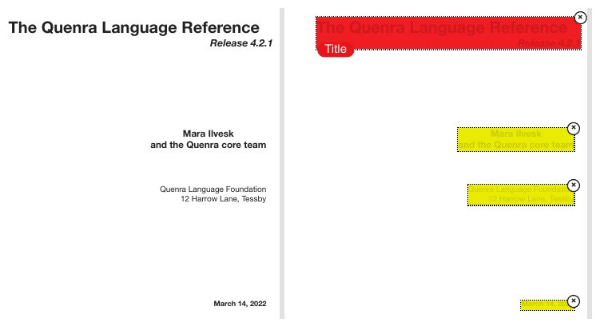
Title MUST be used only for the document's overall title. Authors, dates, addresses and other front-matter prose MUST stay separate Text elements.
Red = Title · yellow = Textblock-title-text
Release 4.2.1 line, then three Text elements — the authors, the foundation's address, the date.
Each Text element keeps its printed line break.Source page
Expected output
The Quenra Language Reference Release 4.2.1
Mara Ilvesk and the Quenra core team
Quenra Language Foundation 12 Harrow Lane, Tessby
March 14, 2022
# The Quenra Language Reference *Release 4.2.1*

Mara Ilvesk
and the Quenra core team

Quenra Language Foundation
12 Harrow Lane, Tessby

March 14, 2022Section-header and List-item
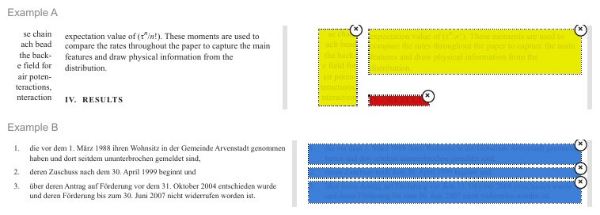
Each visually distinct Section-header MUST be its own element. Each list item MUST be one List-item element, including its bullet or number and every continuation line.
Dark red = Section-header · blue = List-item · yellow = Textblock-section-list
IV. RESULTS (Section-header). Example B: three numbered items, each one List-item whose box
takes in its number and its wrapped second line.Source page
Expected output · Example A
se chain
ach bead
the back-
e field for
air poten-
teractions,
nteraction

expectation value of ($$\tau^{n}/n!$$). These moments are used to compare the rates throughout the paper to capture the main features and draw physical information from the distribution.
IV. RESULTS
se chain
ach bead
the back-
e field for
air poten-
teractions,
nteraction
expectation value of ($$\tau^{n}/n!$$). These moments are used to compare the rates throughout the paper to capture the main features and draw physical information from the distribution.
IV. RESULTS
Expected output · Example B
- die vor dem 1. März 1988 ihren Wohnsitz in der Gemeinde Arvenstadt genommen haben und dort seitdem ununterbrochen gemeldet sind,
- deren Zuschuss nach dem 30. April 1999 beginnt und
- über deren Antrag auf Förderung vor dem 31. Oktober 2004 entschieden wurde und deren Förderung bis zum 30. Juni 2007 nicht widerrufen worden ist.
1. die vor dem 1. März 1988 ihren Wohnsitz in der Gemeinde Arvenstadt genommen haben und dort seitdem ununterbrochen gemeldet sind,
2. deren Zuschuss nach dem 30. April 1999 beginnt und
3. über deren Antrag auf Förderung vor dem 31. Oktober 2004 entschieden wurde und deren Förderung bis zum 30. Juni 2007 nicht widerrufen worden ist.Footnote and Formula
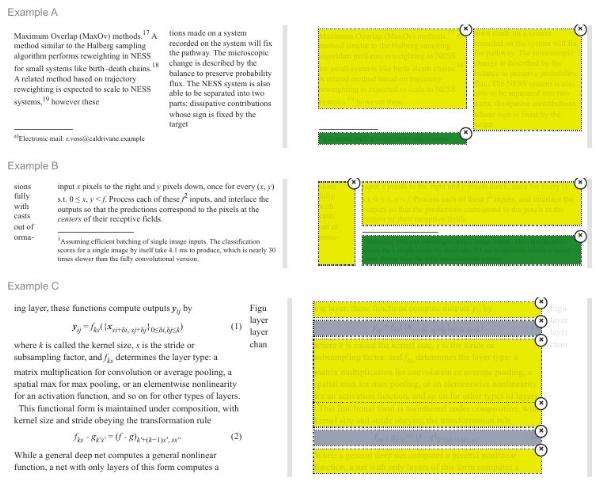
Each distinct Footnote MUST be its own element. A Formula MUST contain the complete displayed expression and its equation number; inline maths stays part of its Text element.
Dark green = Footnote · grey = Formula · yellow = Textblock-footnote-formula
a) under the left column. Example B: a clipped neighbouring column, a paragraph with
inline maths, and footnote 1. Example C: prose interrupted by the numbered displays (1) and (2),
each one Formula with its number; the prose above, between and below them is four Text elements.
The clipped fragments at the right edge of Example C (Figu, layer, …) have no box in the
overlay and are left out.Source page
Expected output · Example A
Maximum Overlap (MaxOv) methods.17 A method similar to the Halberg sampling algorithm performs reweighting in NESS for small systems like birth–death chains.18 A related method based on trajectory reweighting is expected to scale to NESS systems,19 however these
a)Electronic mail: r.voss@caldrivane.example
tions made on a system recorded on the system will fix the pathway. The microscopic change is described by the balance to preserve probability flux. The NESS system is also able to be separated into two parts: dissipative contributions whose sign is fixed by the target
Maximum Overlap (MaxOv) methods.<sup>17</sup> A method similar to the Halberg sampling algorithm performs reweighting in NESS for small systems like birth–death chains.<sup>18</sup> A related method based on trajectory reweighting is expected to scale to NESS systems,<sup>19</sup> however these

<sup>a)</sup>Electronic mail: r.voss@caldrivane.example

tions made on a system recorded on the system will fix the pathway. The microscopic change is described by the balance to preserve probability flux. The NESS system is also able to be separated into two parts: dissipative contributions whose sign is fixed by the target
Expected output · Example B
sions fully with casts out of orma-
input $$x$$ pixels to the right and $$y$$ pixels down, once for every $$(x, y)$$ s.t. $$0 \le x, y < f$$. Process each of these $$f^{2}$$ inputs, and interlace the outputs so that the predictions correspond to the pixels at the centers of their receptive fields.
1Assuming efficient batching of single image inputs. The classification scores for a single image by itself take 4.1 ms to produce, which is nearly 30 times slower than the fully convolutional version.
sions
fully
with
casts
out of
orma-

input $$x$$ pixels to the right and $$y$$ pixels down, once for every $$(x, y)$$ s.t. $$0 \le x, y < f$$. Process each of these $$f^{2}$$ inputs, and interlace the outputs so that the predictions correspond to the pixels at the centers of their receptive fields.

<sup>1</sup>Assuming efficient batching of single image inputs. The classification scores for a single image by itself take 4.1 ms to produce, which is nearly 30 times slower than the fully convolutional version.
Expected output · Example C
ing layer, these functions compute outputs $$\mathbf{y}_{ij}$$ by
$$\mathbf{y}{ij} = f{ks}({\mathbf{x}{si+\delta i,, sj+\delta j}}{0 \le \delta i, \delta j \le k})$$ (1)
where $$k$$ is called the kernel size, $$s$$ is the stride or subsampling factor, and $$f_{ks}$$ determines the layer type: a matrix multiplication for convolution or average pooling, a spatial max for max pooling, or an elementwise nonlinearity for an activation function, and so on for other types of layers.
This functional form is maintained under composition, with kernel size and stride obeying the transformation rule
$$f_{ks} \circ g_{k's'} = (f \circ g)_{k'+(k-1)s',, ss'}.$$ (2)
While a general deep net computes a general nonlinear function, a net with only layers of this form computes a
Page-header and Page-footer
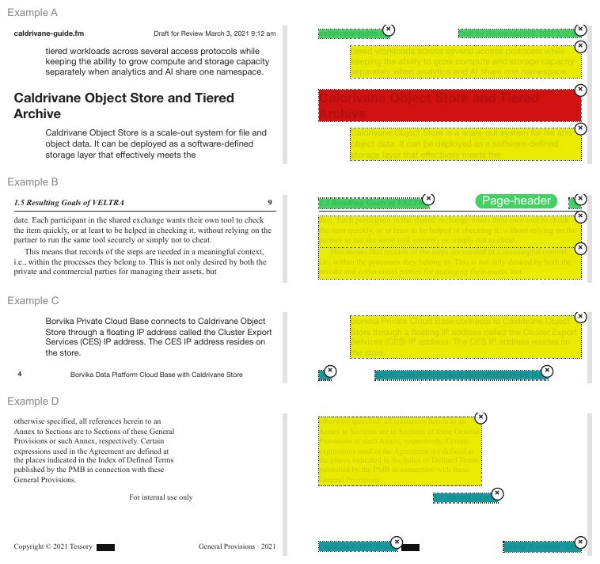
Page-header and Page-footer cover marginal content outside the main flow. Widely separated components of one band MUST be separate elements, and a page number alone qualifies as a Page-footer.
Bright green = Page-header · teal = Page-footer · red = Section-header · yellow = Textblock-header-footer
9) over two paragraphs. C: a paragraph
over two Page-footers (folio 4, running title). D: a paragraph over three Page-footers — a
centred For internal use only, then the copyright line and the running title. A small solid black
bar after the copyright line carries no text and has no box.Source page
Expected output · Example A
caldrivane-guide.fm
Draft for Review March 3, 2021 9:12 am
tiered workloads across several access protocols while keeping the ability to grow compute and storage capacity separately when analytics and AI share one namespace.
Caldrivane Object Store and Tiered Archive
Caldrivane Object Store is a scale-out system for file and object data. It can be deployed as a software-defined storage layer that effectively meets the
**caldrivane-guide.fm**

Draft for Review March 3, 2021 9:12 am

tiered workloads across several access protocols while keeping the ability to grow compute and storage capacity separately when analytics and AI share one namespace.
Caldrivane Object Store and Tiered Archive
Caldrivane Object Store is a scale-out system for file and object data. It can be deployed as a software-defined storage layer that effectively meets the
Expected output · Example B
1.5 Resulting Goals of VELTRA
9
date. Each participant in the shared exchange wants their own tool to check the item quickly, or at least to be helped in checking it, without relying on the partner to run the same tool securely or simply not to cheat.
This means that records of the steps are needed in a meaningful context, i.e., within the processes they belong to. This is not only desired by both the private and commercial parties for managing their assets, but
***1.5 Resulting Goals of VELTRA***

9

date. Each participant in the shared exchange wants their own tool to check the item quickly, or at least to be helped in checking it, without relying on the partner to run the same tool securely or simply not to cheat.

This means that records of the steps are needed in a meaningful context, i.e., within the processes they belong to. This is not only desired by both the private and commercial parties for managing their assets, but
Expected output · Examples C and D
Borvika Private Cloud Base connects to Caldrivane Object Store through a floating IP address called the Cluster Export Services (CES) IP address. The CES IP address resides on the store.
4
Borvika Data Platform Cloud Base with Caldrivane Store
```markdown
otherwise specified, all references herein to an Annex to Sections are to Sections of these General Provisions or such Annex, respectively. Certain expressions used in the Agreement are defined at the places indicated in the Index of Defined Terms published by the PMB in connection with these General Provisions.

For internal use only
Copyright © 2021 Tessory
General Provisions · 2021
More
Rule id layout-block-classes · rule layout blocks