Accepted Alternatives
Where does a page genuinely admit two renderings?
In detail
Situations where a page genuinely admits two renderings. Both conform. The middle column is the canonical form a producer SHOULD emit; the right column is also conforming, and a checker MUST treat the two as equal. Within one document, a producer MUST use one of them throughout — see Choices Made Once Per Document (§4.2).
| Situation | Canonical rendering | Also conforming |
|---|---|---|
| Continuation blocks | separate tables, headers copied | stacked as a single table; the source-printed wide grid is also accepted when blocks share one enclosing frame |
| Blank space beside a header label | unmerged blank cells | rowspan/colspan onto the label |
| Empty region inside a body | either | leading empty <td>s ≡ one blank colspan/rowspan block |
| Purely blank spacer rows | the real ones rendered | presence ≡ absence |
| Currency glyph | one cell, $ 277.09 |
$-gutter colspan pair |
Marker gutters (i)/(ii) |
own column | merged "(i) text" cell |
| Section-divider rows | bold body row | <th> |
| Bullet list in a cell | <ul><li> |
<br/>• |
| Line break inside a label | <br/> if deliberate, flat if incidental |
either, when the page cannot settle it |
| Label and value in one cell | — | split across two existing columns |
| Totals block with no framing signal either way | — | footer rows ≡ its own key-value table |
Reading the examples. Each one pairs a source page with the output the rule expects. ✅ Sample: the rule applies. ❌ Counter-sample: it looks like it applies and does not, or a rendering got it wrong. A non-conforming output, in red, is shown only for contrast. … marks content left out of an excerpt.
The point, in a small example
Both displayed encodings conform for this genuinely blank spacer row. Pick one treatment and apply it consistently wherever the same situation recurs in the document. These pages are made up to isolate the rule.
A real blank row admits two encodings
The empty ruled row is a purely decorative spacer, not the only boundary between groups. Keeping it (shown here) and omitting it both conform. Once chosen, use the same treatment for this situation throughout the document. The second snippet is the alternative output, not extra document content.
Source page
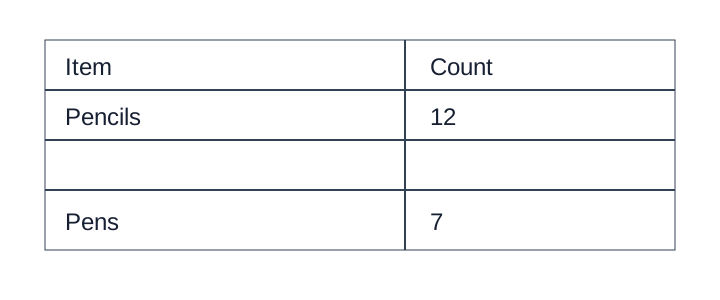
Expected output
<table>
<tr><th>Item</th><th>Count</th></tr>
<tr><td>Pencils</td><td>12</td></tr>
<tr><td></td><td></td></tr>
<tr><td>Pens</td><td>7</td></tr>
</table>
Expected output
<table>
<tr><th>Item</th><th>Count</th></tr>
<tr><td>Pencils</td><td>12</td></tr>
<tr><td>Pens</td><td>7</td></tr>
</table>Visually identical characters
These pairs never count as a difference in text:
- µ (U+00B5) ≡ μ (U+03BC)
- non-breaking hyphen (U+2011) ≡ hyphen-minus (U+002D)
- minus sign (U+2212) ≡ hyphen-minus (U+002D) — hyphen-minus is canonical
- figure and en dashes ≡ hyphen in numeric ranges
- non-breaking space ≡ space
The equivalence governs comparison only. A producer SHOULD transcribe the character the page prints and MUST NOT substitute a "cleaner" code point.
The costly one
Blank space beside a header label matters most, because the two renderings claim different things about the page. The canonical rendering is unmerged blank cells; a span SHOULD be extended only where the page shows a genuinely merged cell — see Barely-Existing Columns and Headers (§9.3.1).
HTML table sections
thead, tbody and tfoot wrappers, or their absence, are equivalent. Rows MUST stay in printed
order and th/td MUST be decided per cell; a total MUST NOT move to fit a wrapper. See
Total and Subtotal Rows (§9.5.6).