Music Notation
A printed staff—what can be transcribed around it?
✅ NormativeSettled. The requirement holds as written.📄 Page ruleCan be applied from the page alone.Read §13.2 in the RFC ↗
Every string printed on a music page MUST be transcribed as ordinary text. The staves themselves
MUST be described, not encoded: each staff region is a fenced description block in the shared fixed
shape, and no notes are read into note names, ABC, LilyPond or MusicXML.
When it applies
A page of printed staves. The notes on the staff have no agreed textual form yet, but a music page is rarely only staves: it carries a great deal of ordinary printed text, and none of that may be lost while the staff question is open.
Reading the examples. Each one pairs a source page with the output the rule expects. ✅ Sample: the rule applies. ❌ Counter-sample: it looks like it applies and does not, or a rendering got it wrong. A non-conforming output, in red, is shown only for contrast. … marks content left out of an excerpt.
Requirements
- Every printed string MUST be transcribed. Titles, composer and arranger credits, instrument names, tempo and expression markings, dynamics, lyrics under the staff, bar numbers, rehearsal letters, chord symbols, footnotes and copyright lines are text and follow the ordinary text rules.
- Notes MUST NOT be encoded. Reading a staff into pitches is error-prone and cannot be checked by reading the page; a wrong transcription is worse than an honest description (never invent). No note names and no music notation (ABC, LilyPond, MusicXML) appear in the output.
- Each staff region MUST be described as a fenced
descriptionblock in the fixed shape shared by every described figure (see Slide Diagrams (§12.2.5)):- one line saying what it is — how many staves, for what instruments where printed, the clef, key and time signature as drawn, the number of bars;
- one bullet per text symbol printed on the staff — chord symbols, rehearsal letters, bar numbers, dynamics — verbatim, followed only by where it is drawn;
- lyrics printed under a staff are text and follow the block.
a four-bar lead sheet
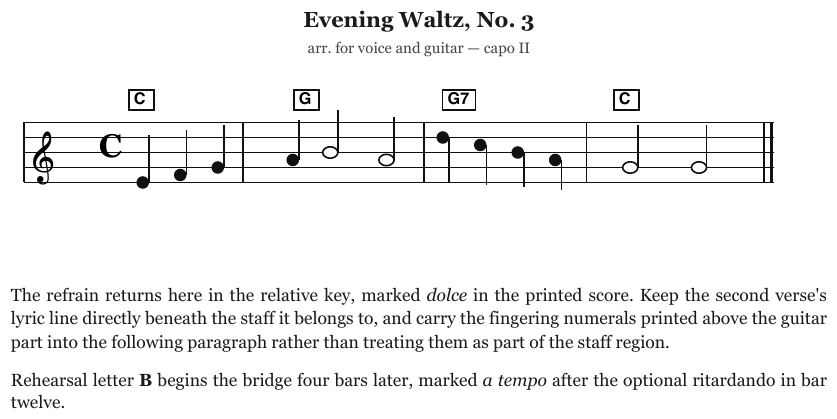
A title, an arrangement line, one treble-clef staff of four bars in common time with a boxed chord symbol over each bar, and two paragraphs of prose below. The staff is described; its four chord symbols are its labels; no notes are encoded.
Source page
Expected output
Evening Waltz, No. 3
arr. for voice and guitar — capo II
One treble-clef staff of four bars, common time, ending with a final barline.
- **C**: boxed chord symbol above bar 1
- **G**: boxed chord symbol above bar 2
- **G7**: boxed chord symbol above bar 3
- **C**: boxed chord symbol above bar 4
The refrain returns here in the relative key, marked dolce in the printed score. Keep the second verse's lyric line directly beneath the staff it belongs to, and carry the fingering numerals printed above the guitar part into the following paragraph rather than treating them as part of the staff region.
Rehearsal letter B begins the bridge four bars later, marked a tempo after the optional ritardando in bar twelve.
## Evening Waltz, No. 3

arr. for voice and guitar — capo II
One treble-clef staff of four bars, common time, ending with a final barline.
- **C**: boxed chord symbol above bar 1
- **G**: boxed chord symbol above bar 2
- **G7**: boxed chord symbol above bar 3
- **C**: boxed chord symbol above bar 4
Neighbouring rules, and how they differ
More
Rule id other-music-notation · other images diagrams