Duplicated Tables
The same table appears twice—keep both or deduplicate?
✅ NormativeSettled. The requirement holds as written.📄 Page ruleCan be applied from the page alone.Read §9.2.4 in the RFC ↗
Every printed occurrence of a table MUST be rendered, in reading order, each as its own table — including a table the page prints twice. Transcription is not summarisation: page content MUST NOT be deduplicated.
When it applies
Page prints:                    Non-conforming:
[Table X]  …  [Table X again]   [Table X]     ← second copy silently dropped
Reading the examples. Each one pairs a source page with the output the rule expects. ✅ Sample: the rule applies. ❌ Counter-sample: it looks like it applies and does not, or a rendering got it wrong. A non-conforming output, in red, is shown only for contrast. … marks content left out of an excerpt.
Requirements
- Identical repeats MUST NOT be collapsed into one, and the second copy MUST NOT be replaced with a note that it repeats the first (never drop).
- Duplication MUST be judged from the rendered page. A table seen once on the page is there once, whatever the underlying text layer says (never invent).
The trap
A PDF's text layer can carry a phantom second copy of a run — from a shadow effect, an overprint, or a quirk of whatever generated the file — that never appears on screen. Judged from extracted text rather than from the page as rendered, a duplicate can be "found" that does not exist, or two visually identical blocks can be missed as both printed.
The rule that resolves it is the one in Cell Text Fidelity (§9.6.3) and The Page Is the Ground Truth (§2.1): the image is the authority, the text layer is a hint.
Repeated template is not duplication
Blocks with an identical header schema but different numbers are separate tables with real, distinct content — not copies. Three panels of the same shape showing 89%/11%, 100%/0% and so on are three tables, and none of them is a duplicate of another. The data, not the layout, decides.
Three NYSE/AMEX/NASDAQ tables with an identical header schemaabout-disclosures-order-routing-2005q2
Three NYSE/AMEX/NASDAQ tables with an identical header schema — but distinct data (89%/11% vs
100%/0%). A repeated template, not a duplicate: all three are rendered. The Total Customer Orders rows are bold.
Source page
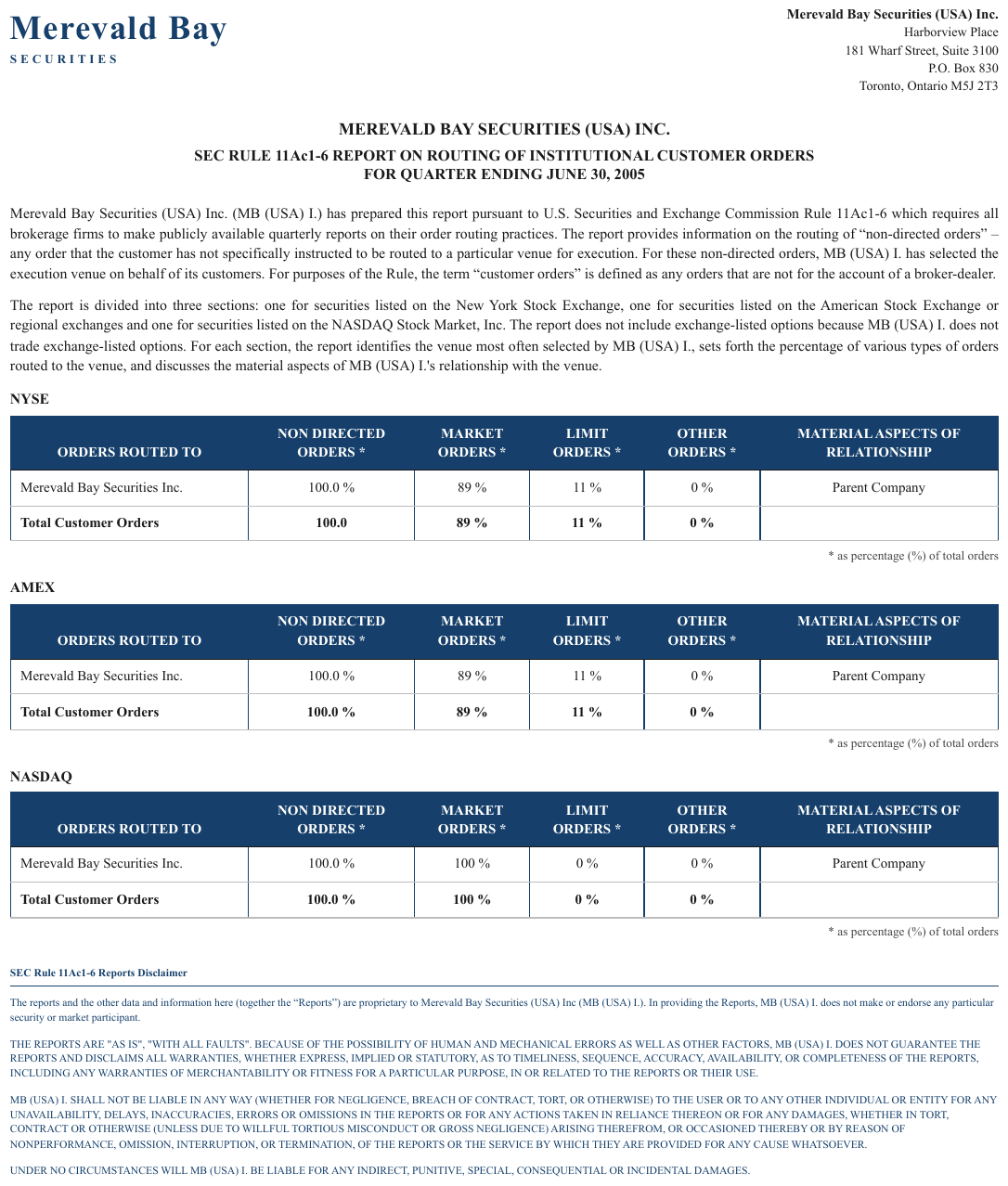
Expected output · excerpt, table 1 of 3
| ORDERS ROUTED TO | NON DIRECTED ORDERS \* | MARKET ORDERS \* | LIMIT ORDERS \* | OTHER ORDERS \* | MATERIAL ASPECTS OF RELATIONSHIP |
|---|---|---|---|---|---|
| Merevald Bay Securities Inc. | 100.0 % | 89 % | 11 % | 0 % | Parent Company |
| Total Customer Orders | 100.0 | 89 % | 11 % | 0 % |
* as percentage (%) of total orders
…
Neighbouring rules, and how they differ
More
Rule id tables-duplicated-tables · tables fidelity