Chemical Molecules
A chemical formula or structure—how is it encoded?
✅ NormativeSettled. The requirement holds as written.📄 Page ruleCan be applied from the page alone.Read §13.1 in the RFC ↗
Linear formulae, ions and reactions MUST be written with \ce{...}, and drawn structures, rings
and branches with \chemfig{...}. Standalone chemical markup MUST be placed in a fenced latex
block. Legible structure MUST be preserved; an unreadable portion MUST be described rather than
guessed.
When it applies
Structural formulae and reaction equations printed as figures.
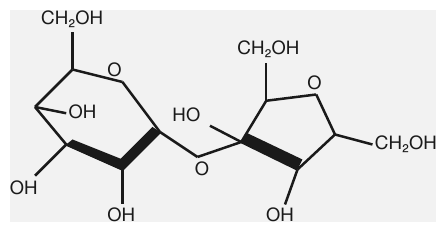
A structural formula printed as a figure — exactly the case a prose description cannot reconstruct.
Reading the examples. Each one pairs a source page with the output the rule expects. ✅ Sample: the rule applies. ❌ Counter-sample: it looks like it applies and does not, or a rendering got it wrong. A non-conforming output, in red, is shown only for contrast. … marks content left out of an excerpt.
The point, in a small example
Compare a linear reaction, a ring and stereochemical bonds. Each source was rendered from the complete displayed mhchem or chemfig encoding. These pages are made up to isolate the rule.
A printed reaction keeps coefficients and its arrow
Use mhchem for a linear reaction. Preserve the printed coefficients and arrow; do not replace the reaction with its name or add conditions that are not printed.
Source page
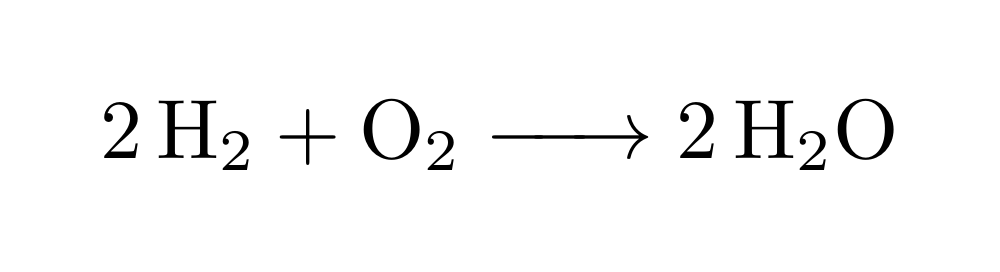
Expected output
```latex
\ce{2H2 + O2 -> 2H2O}
```A ring needs its bond pattern
The six-membered ring has three alternating double bonds. A formula such as C6H6 alone would discard the drawn structure. This is a complete chemfig encoding of the shown ring.
Source page
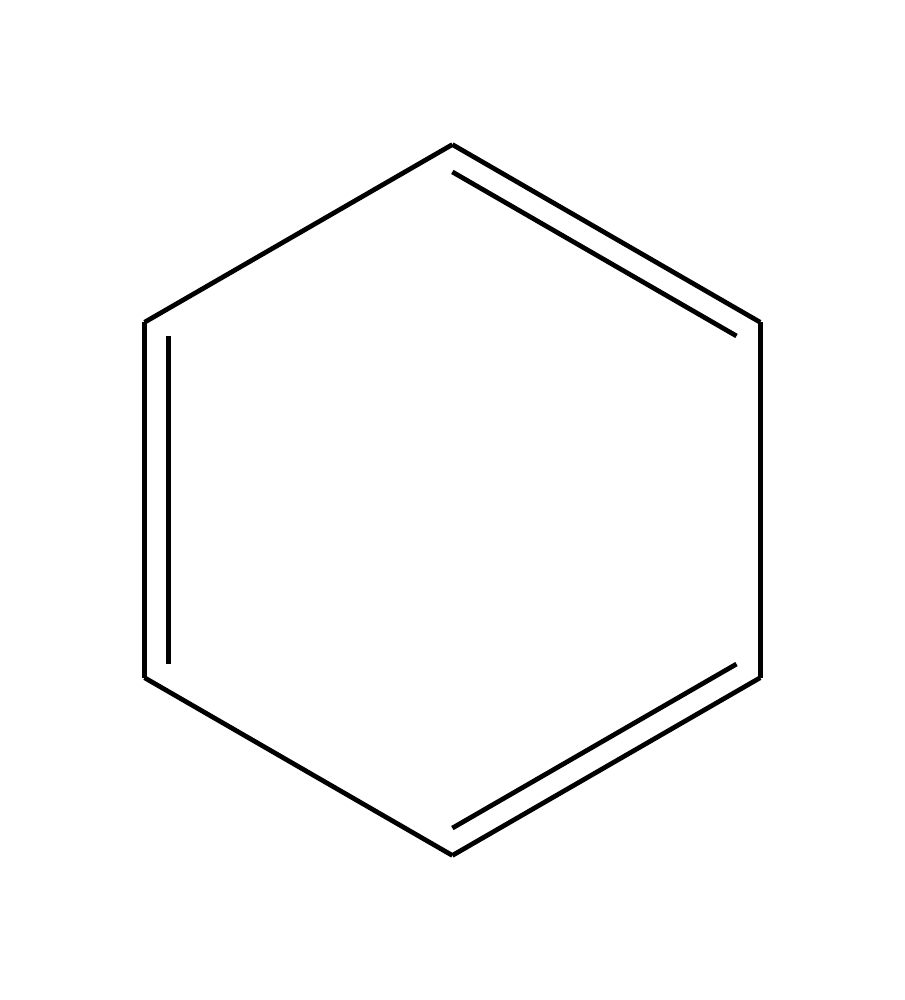
Expected output
```latex
\chemfig{*6(-=-=-=)}
```Solid and hashed wedges must survive
Preserve the solid wedge to F, hashed wedge to Br and ordinary bonds to H and Cl. Do not flatten them to four identical bonds or infer an R/S name not printed on the source.
Source page
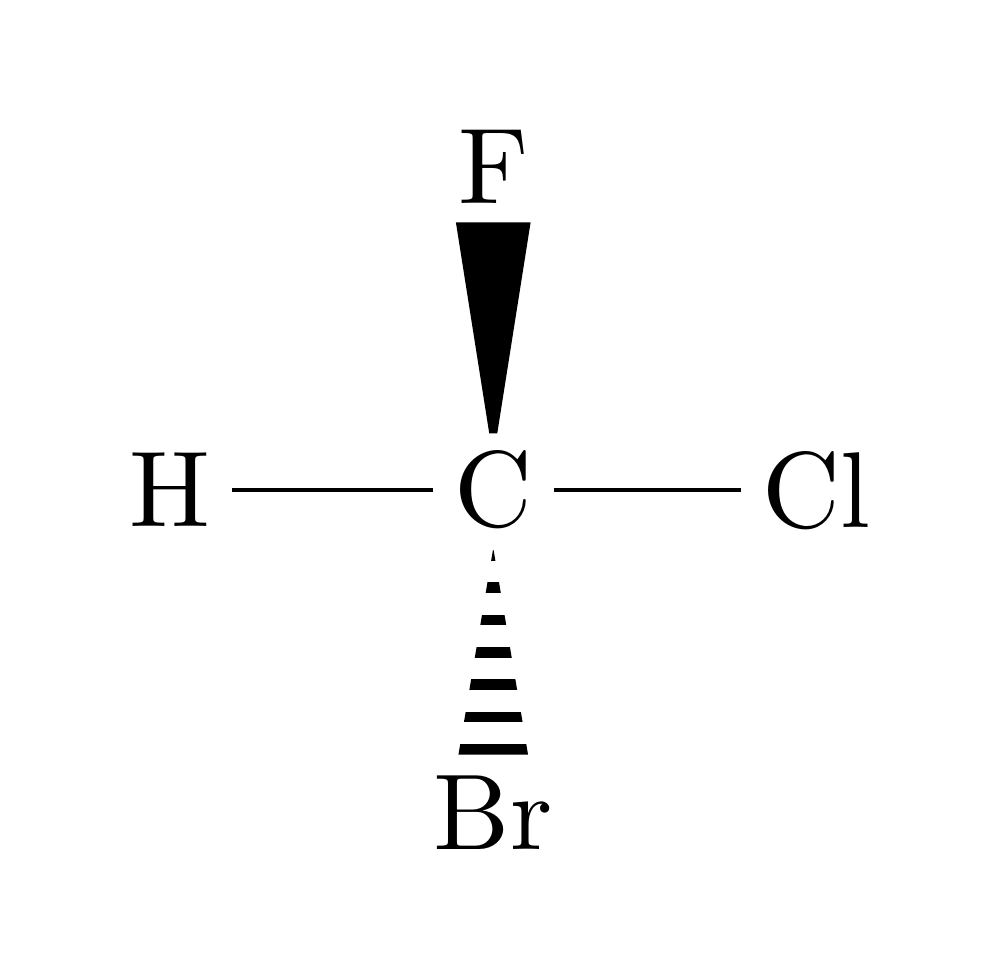
Expected output
```latex
\chemfig{C(-[:180]H)(-[:0]Cl)(<[:90]F)(<:[:270]Br)}
```Which markup
The markup follows what is printed:
| Printed | Markup | Examples |
|---|---|---|
| A formula, ion or reaction written on a line | mhchem — \ce{...} |
\ce{SO4^2-}, \ce{2H2 + O2 -> 2H2O} |
| A 2D molecular structure: rings, branches, drawn bonds | chemfig — \chemfig{...} |
a ring with its substituents |
Why a code representation rather than a description
A structural formula is exactly reconstructable — unlike a photograph, it has a canonical textual encoding that a chemist or a downstream tool can render back to the same picture. A prose description ("a benzene ring with a hydroxyl group") is lossy and unverifiable, and it silently discards stereochemistry, charges and substituent positions. A legible structure therefore MUST NOT be rendered as prose.
The same reasoning governs Electrical Schematics (§12.2.3) and Blueprints (§12.2.1): a domain-specific code block is preferred wherever a faithful one exists.
Placement and unreadable structures
- A formula standing on its own — a displayed structure or reaction — MUST be in a fenced
latexblock. - Every legible atom, bond, charge and substituent MUST be kept (never drop).
- Where part of a structure cannot be read, that part MUST be described in words, and the output MUST NOT fill it in with a plausible guess (never invent).
Neighbouring rules, and how they differ
More
Rule id other-chemical-molecules · other rule images diagrams math