Bottom Edge Totals and Islands
Text just below the ruled frame—part of the table or not?
✅ NormativeSettled. The requirement holds as written.📄 Page ruleCan be applied from the page alone.Read §9.7.1 in the RFC ↗
Content printed below or beside a table MUST NOT be dropped, even when it sits outside the ruled frame. Where it continues the table's ruled grid it MUST be rendered as rows of that table; where it stands apart as its own unbordered block it MUST be rendered as its own small key-value table.
When it applies
The bottom edge is where content goes missing most often, because everything here sits past the last rule of the frame — and it is usually the numbers the reader actually wanted.
| Item   | Qty | Rate | Amount |
| Widget | 2   | 30   | 60     |
└──── ruled frame ends ────────┘
               Subtotal    60      ← outside the frame:
               Shipping    10        footer rows of the table? its own KV
               Total       70        table? dropped entirely?
Reading the examples. Each one pairs a source page with the output the rule expects. ✅ Sample: the rule applies. ❌ Counter-sample: it looks like it applies and does not, or a rendering got it wrong. A non-conforming output, in red, is shown only for contrast. … marks content left out of an excerpt.
The frame decides
The block under the table is placed by one question: does it sit inside the ruled frame, or visually continue the table's ruled column grid?
| Block under the table | Rendering |
|---|---|
| Inside the frame, or continuing its ruled column grid | footer rows of that table, each value in its printed column |
| Standing apart as a separate unbordered block — even if its columns loosely line up under the table's rightmost columns | its own key-value table: one row per printed line, a label cell and a value cell |
The block MUST NOT be omitted, and a block that is not part of the grid MUST NOT be padded into the main table as extra footer rows. This is the frame test of Titles Banners Captions (§9.7.3), applied at the other edge of the table. Footnotes are the one exception — see Footnotes Inside the Frame (§9.7.2).
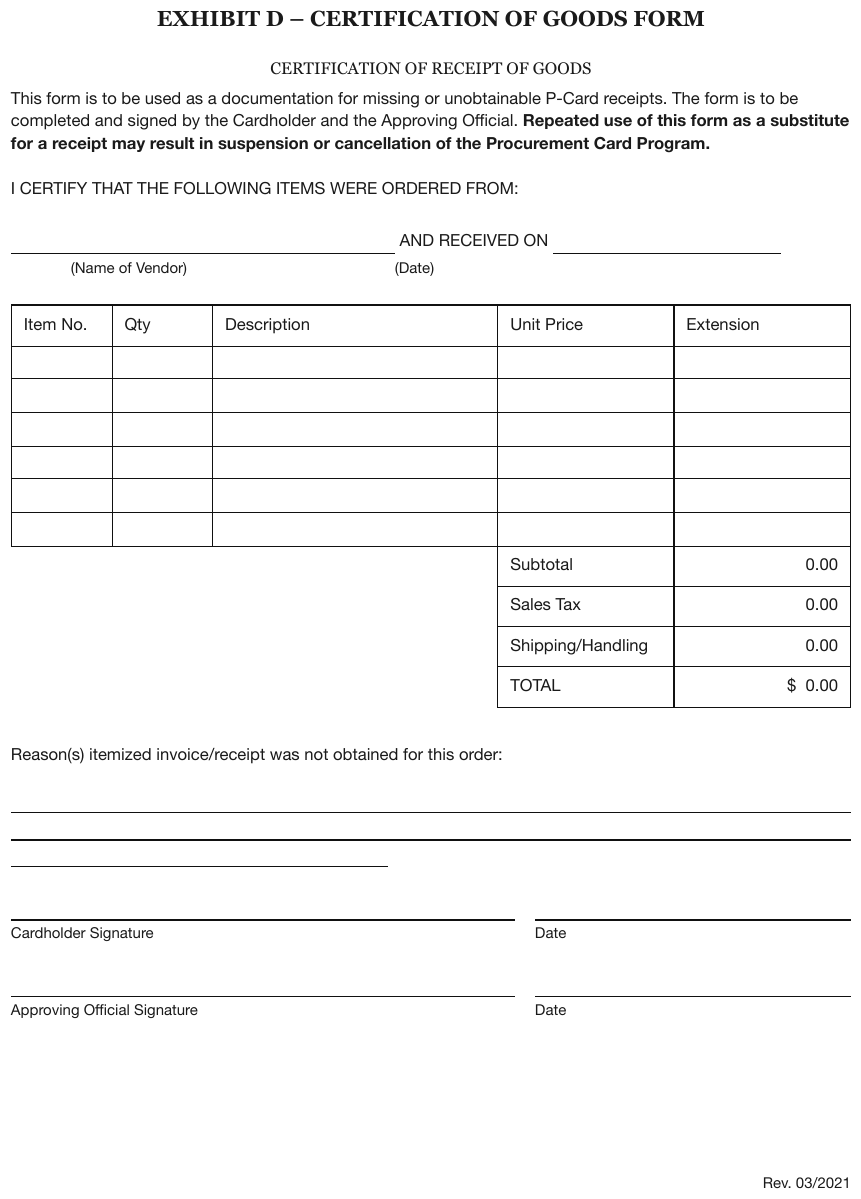
a totals block continuing the frame
Subtotal to TOTAL sit under the item grid inside the frame's two right-hand columns, ruled the
same way, with the left three columns absent below the last item row. They are footer rows of the
item table, label under Unit Price and value under Extension; the printed empty item rows are
kept as empty rows.
Source page
Expected output · the item table
| Item No. | Qty | Description | Unit Price | Extension |
|---|---|---|---|---|
| Subtotal | 0.00 | |||
| Sales Tax | 0.00 | |||
| Shipping/Handling | 0.00 | |||
| TOTAL | $ 0.00 |
Trailing aligned summary lines
Lines such as "Selected …" or "Reserve to Surplus Ratio:" whose values land under real columns are rows of the grid. They MUST be rendered as rows, each value in its printed column — not as prose after the table.
| Year | Reserves | Surplus |
| 2023 | 1,204    | 887     |
Selected             1,190     ← values align under real columns:
Reserve/Surplus:     1.36        rows of the table
Invoice-style totals blocks
A Subtotal / Discount / Shipping / Total block printed below the line-item table and outside its frame MUST be rendered as its own key-value table: label and value, one row per printed line.
This is a deliberate exception to the treatment of ungridded key-value regions in Forms and Key-Value Regions (§10.1). Trailing totals are a numeric continuation of the table's data, and a table whose totals are missing has lost the part of the page most people read first.
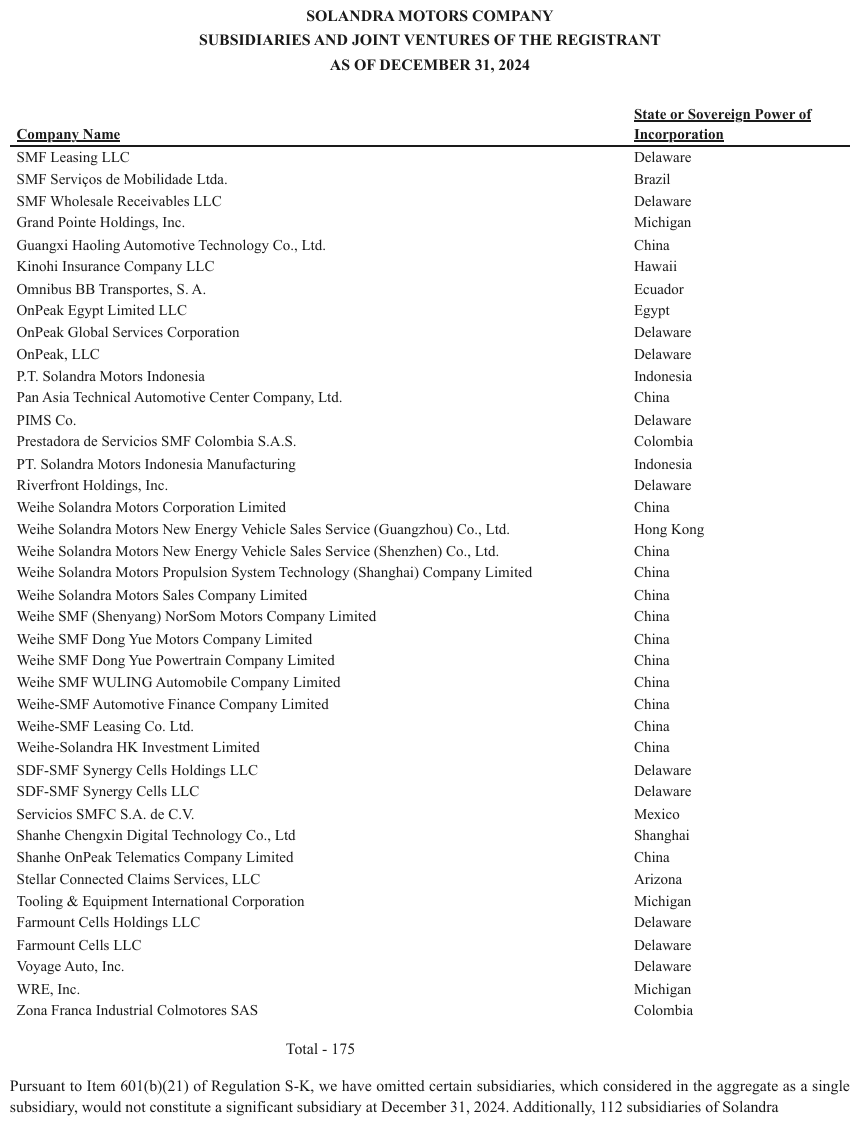
A Total - 175 line below the table2cc
A Total - 175 line below the table, outside its implicit frame and not even aligned with the
second column. It is kept, as its own one-row key-value table after the list. The column headers
are bold and underlined.
Source page
Expected output · excerpt
| Company Name | State or Sovereign Power of Incorporation | |||||||||||||||||||||||||||||||||||||||||||||||||||||||||||||||||||||||||||||||||||||||||||||||||
|---|---|---|---|---|---|---|---|---|---|---|---|---|---|---|---|---|---|---|---|---|---|---|---|---|---|---|---|---|---|---|---|---|---|---|---|---|---|---|---|---|---|---|---|---|---|---|---|---|---|---|---|---|---|---|---|---|---|---|---|---|---|---|---|---|---|---|---|---|---|---|---|---|---|---|---|---|---|---|---|---|---|---|---|---|---|---|---|---|---|---|---|---|---|---|---|---|---|---|
| SMF Leasing LLC | Delaware | |||||||||||||||||||||||||||||||||||||||||||||||||||||||||||||||||||||||||||||||||||||||||||||||||
| SMF Serviços de Mobilidade Ltda. | Brazil | |||||||||||||||||||||||||||||||||||||||||||||||||||||||||||||||||||||||||||||||||||||||||||||||||
| SMF Wholesale Receivables LLC | Delaware | |||||||||||||||||||||||||||||||||||||||||||||||||||||||||||||||||||||||||||||||||||||||||||||||||
| Grand Pointe Holdings, Inc. | Michigan | |||||||||||||||||||||||||||||||||||||||||||||||||||||||||||||||||||||||||||||||||||||||||||||||||
| Guangxi Haoling Automotive Technology Co., Ltd. | China | |||||||||||||||||||||||||||||||||||||||||||||||||||||||||||||||||||||||||||||||||||||||||||||||||
| Kinohi Insurance Company LLC | Hawaii | |||||||||||||||||||||||||||||||||||||||||||||||||||||||||||||||||||||||||||||||||||||||||||||||||
| … | ||||||||||||||||||||||||||||||||||||||||||||||||||||||||||||||||||||||||||||||||||||||||||||||||||
| WRE, Inc. | Michigan | |||||||||||||||||||||||||||||||||||||||||||||||||||||||||||||||||||||||||||||||||||||||||||||||||
| Zona Franca Industrial Colmotores SAS | Colombia | |||||||||||||||||||||||||||||||||||||||||||||||||||||||||||||||||||||||||||||||||||||||||||||||||
| Total - | 175 |
|---|
Detached cell islands
A small offset group of cells that lines up with a table's column tracks is content. It MUST be rendered; it is not decoration.
| (1) | (2) | (3)  |
| 100 | 82  | 0.82 |

            | 0.79 |   ← "(8) Benchmark" offset box, aligned
                         with column (3)'s track
Where it goes is decided by one test: does the island line up with an existing table's column tracks?
- Yes → it belongs to that table and MUST be appended as an extra row: the label in the stub column, the value in the column whose track it lines up with.
- No → it MUST be rendered as its own small table.
Column-track alignment is the typesetter saying "this value belongs under that heading". A floating box that lines up with nothing makes no such claim, so it stands alone.
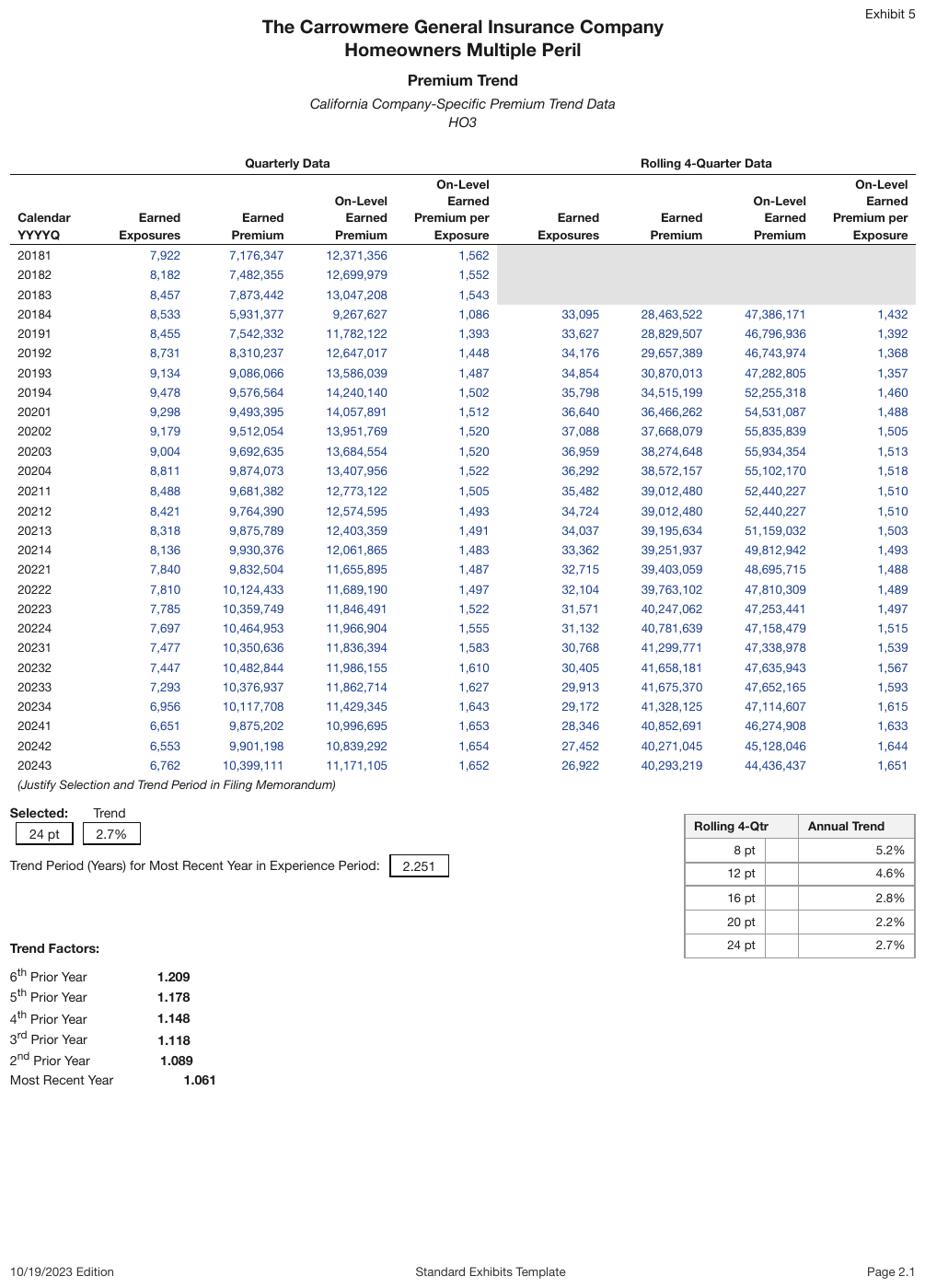
The boxed Selectedwwa
/ Trend values, the boxed trend period and the Rolling 4-Qtr / Annual Trend table sit outside the main frame and do not continue its column grid, so each is its own small table after the main one. The main table's italic footnote line follows it as footnote text.
Source page
Expected output · excerpt, end of table 1 and the islands
| … | ||||||||||||||||||||||||||||||||||||||||||||||||||||||||||||||||||||||||||||||||||||||||||||||||||
| 20243 | 6,762 | 10,399,111 | 11,171,105 | 1,652 | 26,922 | 40,293,219 | 44,436,437 | 1,651 | ||||||||||||||||||||||||||||||||||||||||||||||||||||||||||||||||||||||||||||||||||||||||||
(Justify Selection and Trend Period in Filing Memorandum)
| Selected: | Trend |
|---|---|
| 24 pt | 2.7% |
| Trend Period (Years) for Most Recent Year in Experience Period: | 2.251 |
| Rolling 4-Qtr | Annual Trend | |
|---|---|---|
| 8 pt | 5.2% | |
| 12 pt | 4.6% | |
| 16 pt | 2.8% | |
| 20 pt | 2.2% | |
| 24 pt | 2.7% | |
…
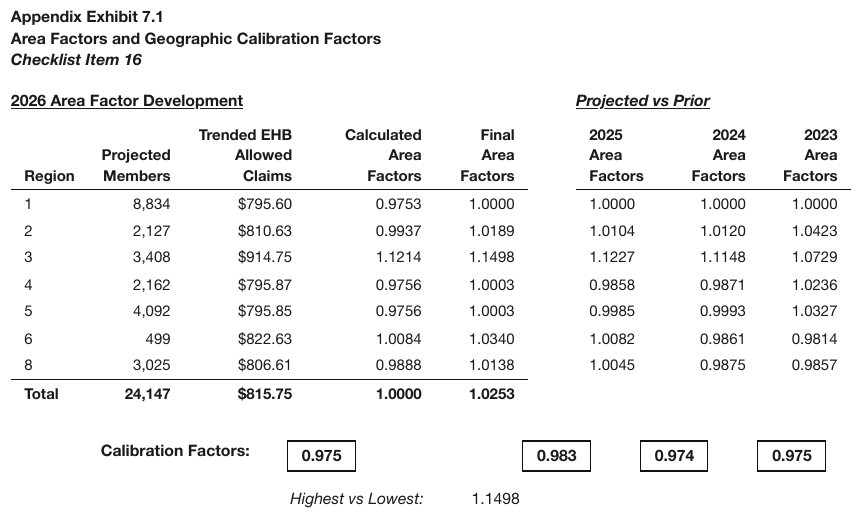
Calibration Factors2tab
Final Area Factors and the three prior-year columns, 1.1498 under Final Area Factors. The two
panels share one Region row spine and are rendered as one wide table (see
Column Continuation (§9.2.2)).Source page
Expected output
| 2026 Area Factor Development | Projected vs Prior | ||||||
|---|---|---|---|---|---|---|---|
| Region | Projected Members | Trended EHB Allowed Claims | Calculated Area Factors | Final Area Factors | 2025 Area Factors | 2024 Area Factors | 2023 Area Factors |
| 1 | 8,834 | $795.60 | 0.9753 | 1.0000 | 1.0000 | 1.0000 | 1.0000 |
| 2 | 2,127 | $810.63 | 0.9937 | 1.0189 | 1.0104 | 1.0120 | 1.0423 |
| 3 | 3,408 | $914.75 | 1.1214 | 1.1498 | 1.1227 | 1.1148 | 1.0729 |
| 4 | 2,162 | $795.87 | 0.9756 | 1.0003 | 0.9858 | 0.9871 | 1.0236 |
| 5 | 4,092 | $795.85 | 0.9756 | 1.0003 | 0.9985 | 0.9993 | 1.0327 |
| 6 | 499 | $822.63 | 1.0084 | 1.0340 | 1.0082 | 0.9861 | 0.9814 |
| 8 | 3,025 | $806.61 | 0.9888 | 1.0138 | 1.0045 | 0.9875 | 0.9857 |
| Total | 24,147 | $815.75 | 1.0000 | 1.0253 | |||
| Calibration Factors: | 0.975 | 0.983 | 0.974 | 0.975 | |||
| Highest vs Lowest: | 1.1498 | ||||||
A boxed Weighted Average Lapse Rate summary detached below the main frame3d
A boxed Weighted Average Lapse Rate summary detached below the main frame, its two values aligned
under the Implied and "Current" lapse-rate columns. It is stitched back in as trailing rows,
each value in the column it lines up with.
Source page
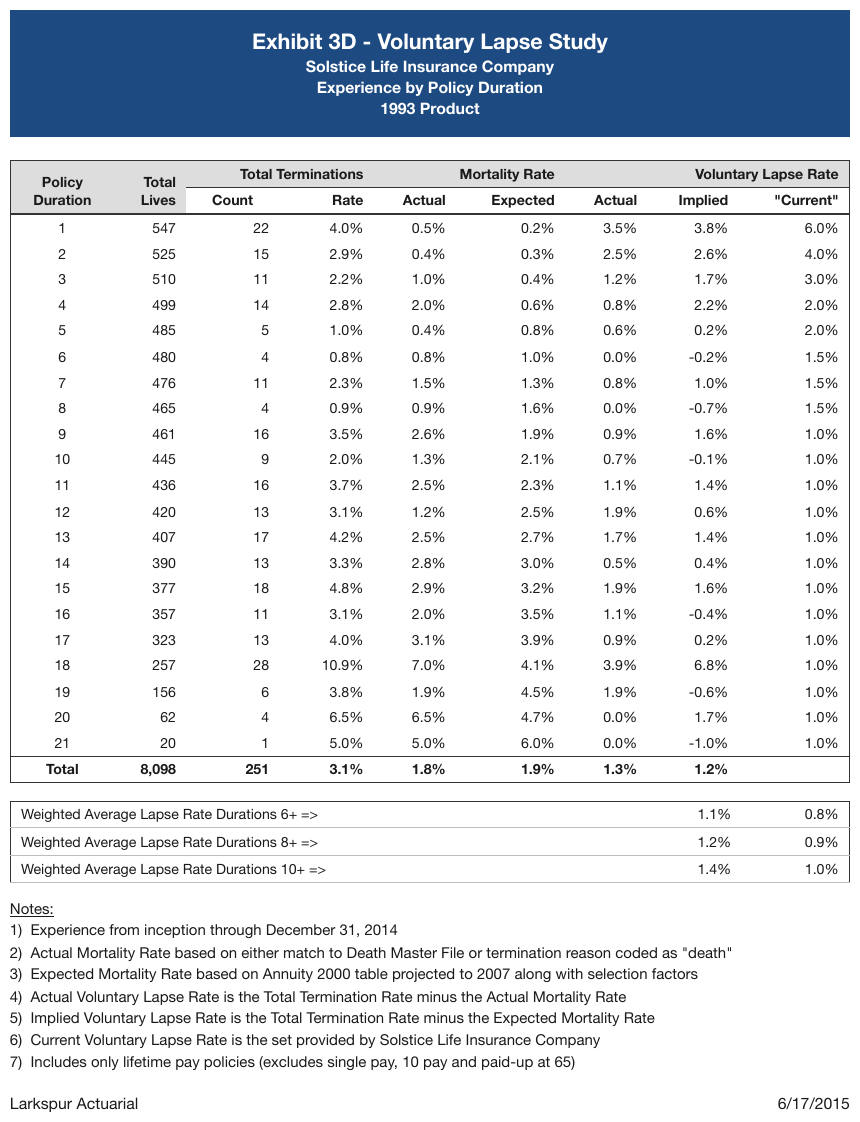
Expected output · excerpt
| Policy Duration | Total Lives | Total Terminations | Mortality Rate | Voluntary Lapse Rate | ||||||||||||||||||||||||||||||||||||||||||||||||||||||||||||||||||||||||||||||||||||||||||||||
|---|---|---|---|---|---|---|---|---|---|---|---|---|---|---|---|---|---|---|---|---|---|---|---|---|---|---|---|---|---|---|---|---|---|---|---|---|---|---|---|---|---|---|---|---|---|---|---|---|---|---|---|---|---|---|---|---|---|---|---|---|---|---|---|---|---|---|---|---|---|---|---|---|---|---|---|---|---|---|---|---|---|---|---|---|---|---|---|---|---|---|---|---|---|---|---|---|---|---|
| Count | Rate | Actual | Expected | Actual | Implied | "Current" | ||||||||||||||||||||||||||||||||||||||||||||||||||||||||||||||||||||||||||||||||||||||||||||
| 1 | 547 | 22 | 4.0% | 0.5% | 0.2% | 3.5% | 3.8% | 6.0% | ||||||||||||||||||||||||||||||||||||||||||||||||||||||||||||||||||||||||||||||||||||||||||
| … | ||||||||||||||||||||||||||||||||||||||||||||||||||||||||||||||||||||||||||||||||||||||||||||||||||
| 21 | 20 | 1 | 5.0% | 5.0% | 6.0% | 0.0% | -1.0% | 1.0% | ||||||||||||||||||||||||||||||||||||||||||||||||||||||||||||||||||||||||||||||||||||||||||
| Total | 8,098 | 251 | 3.1% | 1.8% | 1.9% | 1.3% | 1.2% | |||||||||||||||||||||||||||||||||||||||||||||||||||||||||||||||||||||||||||||||||||||||||||
| Weighted Average Lapse Rate Durations 6+ => | 1.1% | 0.8% | ||||||||||||||||||||||||||||||||||||||||||||||||||||||||||||||||||||||||||||||||||||||||||||||||
| Weighted Average Lapse Rate Durations 8+ => | 1.2% | 0.9% | ||||||||||||||||||||||||||||||||||||||||||||||||||||||||||||||||||||||||||||||||||||||||||||||||
| Weighted Average Lapse Rate Durations 10+ => | 1.4% | 1.0% | ||||||||||||||||||||||||||||||||||||||||||||||||||||||||||||||||||||||||||||||||||||||||||||||||
Boxed Percentage Change2tt
-8.3% / +30.0% values below each frame, aligned under the
Proposed Rate/Factor column, folded back in as trailing rows.
Source page
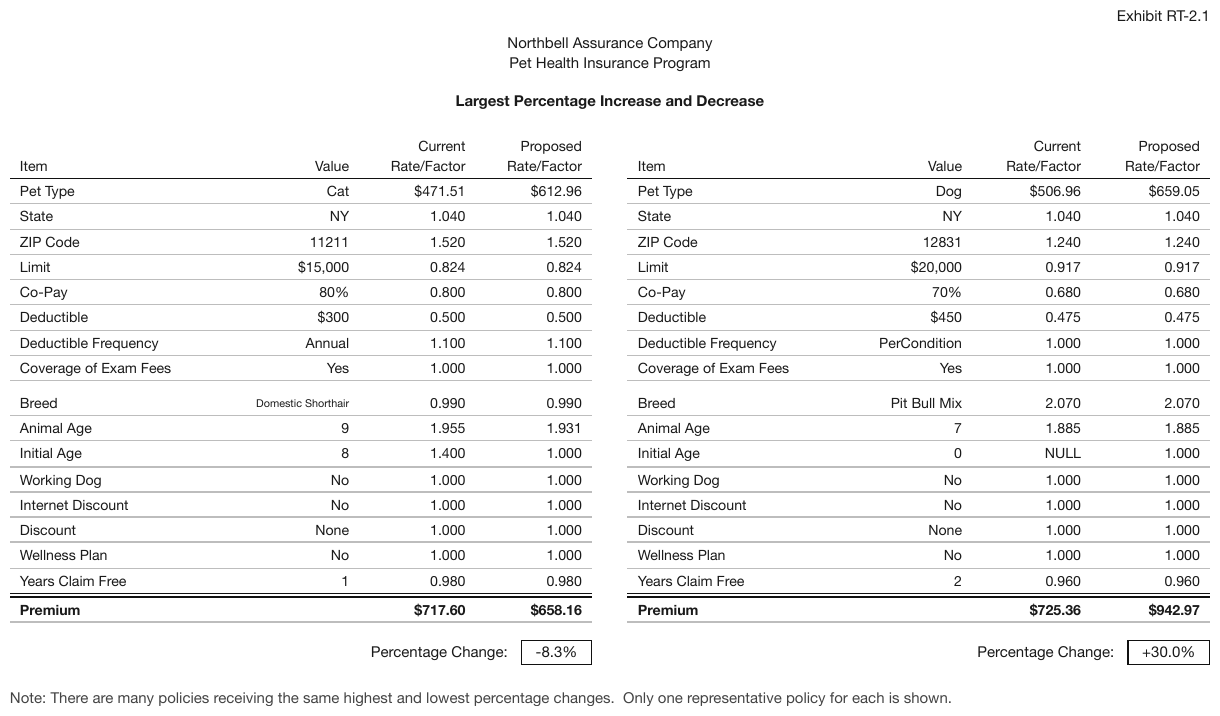
Expected output · excerpt, table 1 of 2
| Item | Value | Current Rate/Factor | Proposed Rate/Factor | |||||||||||||||||||||||||||||||||||||||||||||||||||||||||||||||||||||||||||||||||||||||||||||||
|---|---|---|---|---|---|---|---|---|---|---|---|---|---|---|---|---|---|---|---|---|---|---|---|---|---|---|---|---|---|---|---|---|---|---|---|---|---|---|---|---|---|---|---|---|---|---|---|---|---|---|---|---|---|---|---|---|---|---|---|---|---|---|---|---|---|---|---|---|---|---|---|---|---|---|---|---|---|---|---|---|---|---|---|---|---|---|---|---|---|---|---|---|---|---|---|---|---|---|
| Pet Type | Cat | $471.51 | $612.96 | |||||||||||||||||||||||||||||||||||||||||||||||||||||||||||||||||||||||||||||||||||||||||||||||
| … | ||||||||||||||||||||||||||||||||||||||||||||||||||||||||||||||||||||||||||||||||||||||||||||||||||
| Years Claim Free | 1 | 0.980 | 0.980 | |||||||||||||||||||||||||||||||||||||||||||||||||||||||||||||||||||||||||||||||||||||||||||||||
| Premium | $717.60 | $658.16 | ||||||||||||||||||||||||||||||||||||||||||||||||||||||||||||||||||||||||||||||||||||||||||||||||
| Percentage Change: | -8.3% | |||||||||||||||||||||||||||||||||||||||||||||||||||||||||||||||||||||||||||||||||||||||||||||||||
Alignment on its own is not proof
Alignment places an island once it is known to belong to the table; it cannot by itself prove that
an out-of-frame line is a footer row. On a premium-tax page an underline closes a
Premium Tax / Total mini-table, and the 3. DCCE to Loss Ratio line printed beneath it sits under
the same columns while belonging to neither table.
The frame test MUST be applied first, and alignment used only to place what it hands over — not the other way round.
Where the frame is genuinely ambiguous
Some pages have no ruled border either way. There, both encodings — footer rows of the table, or a separate key-value table — conform, provided every printed line is kept. A document MUST use one of them throughout. See Accepted Alternatives (§A.1) and Choices Made Once Per Document (§4.2).
Neighbouring rules, and how they differ
More
Rule id tables-bottom-edge-totals-and-islands · tables drops boundaries