Displayed Equations
A displayed equation with a number—where does the number go?
✅ NormativeSettled. The requirement holds as written.📄 Page ruleCan be applied from the page alone.Read §7.2.2 in the RFC ↗
Displayed mathematics MUST be written as LaTeX inside $$ … $$. Its printed equation number
MUST follow the closing delimiter as plain text in the same formula block: $$ … $$ (1).
When it applies
A displayed equation is set on its own line, usually centred, often with a number at the right
margin — (1), (2) — that the prose cites.
ΔE = ΔE⁰ − (RT / m·F) [ ln(θ / 1−θ) + fθ + gθ^(3/2) ] (1)
Reading the examples. Each one pairs a source page with the output the rule expects. ✅ Sample: the rule applies. ❌ Counter-sample: it looks like it applies and does not, or a rendering got it wrong. A non-conforming output, in red, is shown only for contrast. … marks content left out of an excerpt.
Requirements
- The delimiters are those of Inline Equations (§7.2.6):
$$ … $$, never single$. - The equation number MUST be kept. It is content — "as shown in (1)" appears in the prose — and dropping it is the one option that loses something (never drop).
- The number MUST be written after the closing
$$, as plain text, in the same block — not inside the LaTeX, and not as a separate paragraph. The Formula block includes its number; see Block Classes (§5.3). - An unnumbered display MUST NOT be given a number.
numbered equations in a two-column article
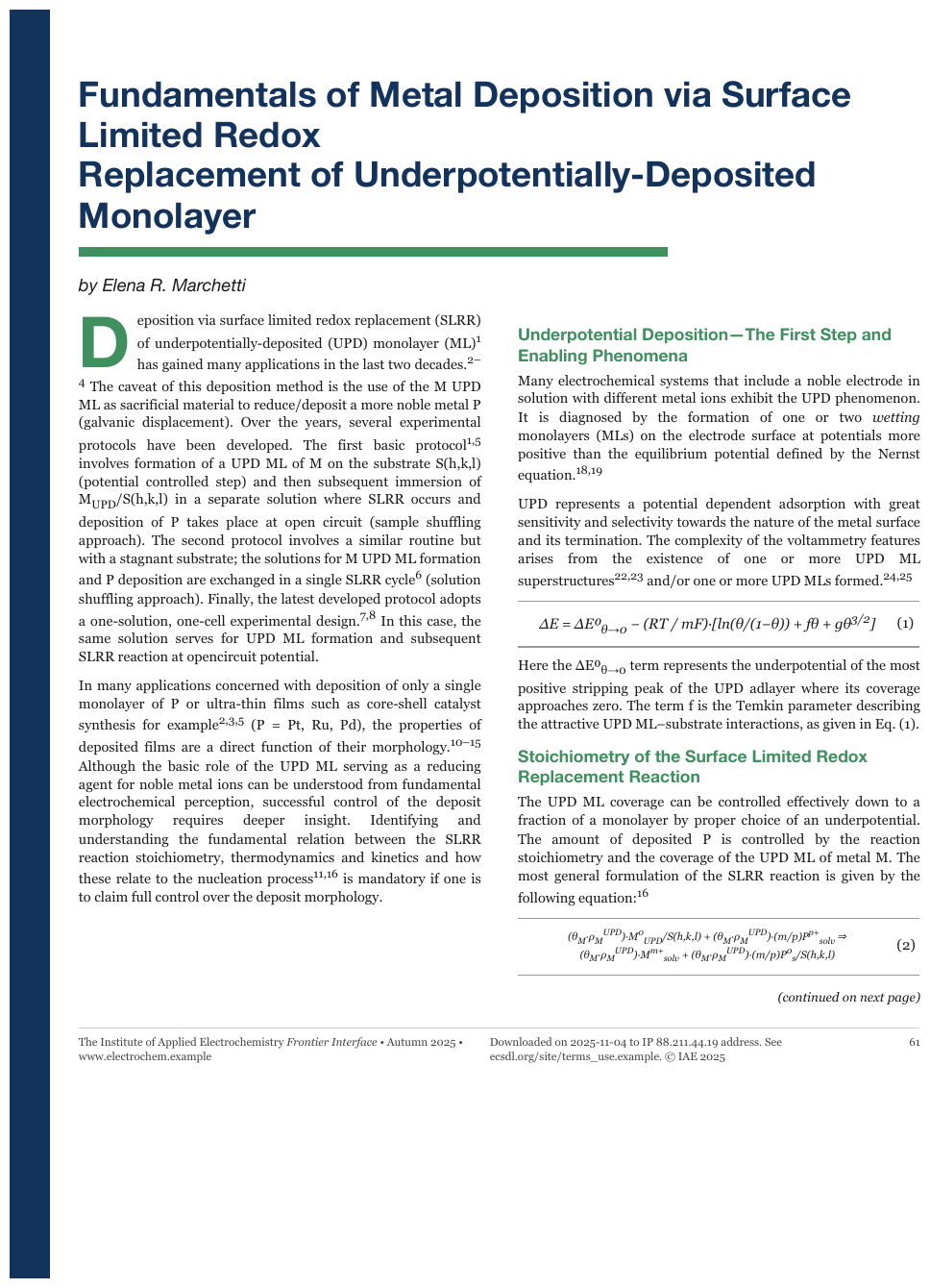
Two display equations, numbered (1) and (2) at the right margin, each cited in the surrounding
text. Equation (2) spans the full column width and wraps after ⇒; the wrap is typesetting, so the
LaTeX is one line. The symbol cited in the prose after (1) is itself maths and takes the inline
form.
Source page
Expected output · excerpt, right column
UPD represents a potential dependent adsorption with great sensitivity and selectivity towards the nature of the metal surface and its termination. The complexity of the voltammetry features arises from the existence of one or more UPD ML superstructures22,23 and/or one or more UPD MLs formed.24,25
$$\Delta E = \Delta E^{0}_{\theta \to 0} - (RT / mF) \cdot [\ln(\theta/(1-\theta)) + f\theta + g\theta^{3/2}]$$ (1)
Here the $$\Delta E^{0}_{\theta \to 0}$$ term represents the underpotential of the most positive stripping peak of the UPD adlayer where its coverage approaches zero. The term f is the Temkin parameter describing the attractive UPD ML–substrate interactions, as given in Eq. (1).
…
The UPD ML coverage can be controlled effectively down to a fraction of a monolayer by proper choice of an underpotential. The amount of deposited P is controlled by the reaction stoichiometry and the coverage of the UPD ML of metal M. The most general formulation of the SLRR reaction is given by the following equation:16
$$(\theta_{M} \cdot \rho_{M}^{\mathrm{UPD}}) \cdot M^{0}{\mathrm{UPD}}/S(h,k,l) + (\theta{M} \cdot \rho_{M}^{\mathrm{UPD}}) \cdot (m/p)P^{p+}{\mathrm{solv}} \Rightarrow (\theta{M} \cdot \rho_{M}^{\mathrm{UPD}}) \cdot M^{m+}{\mathrm{solv}} + (\theta{M} \cdot \rho_{M}^{\mathrm{UPD}}) \cdot (m/p)P^{0}_{s}/S(h,k,l)$$ (2)
(continued on next page)
a typewritten paper
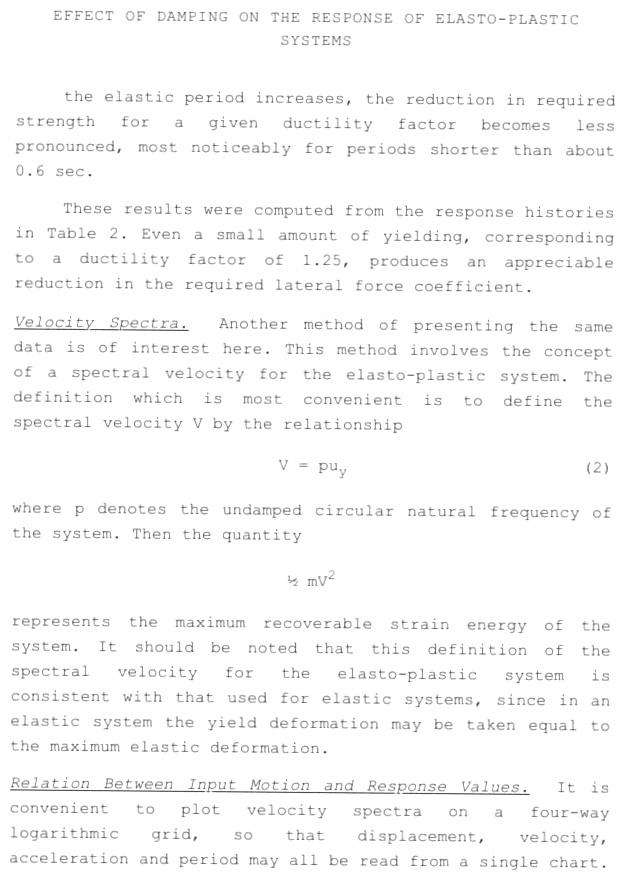
Equation V = pu_y numbered (2) at the right margin, then an unnumbered display ½ mV², in a
scanned typewritten proceedings page. Run-in underlined headings, also set in italic, open two
paragraphs.
Source page
Expected output · excerpt
…
Velocity Spectra. Another method of presenting the same data is of interest here. This method involves the concept of a spectral velocity for the elasto-plastic system. The definition which is most convenient is to define the spectral velocity V by the relationship
$$V = pu_{y}$$ (2)
where p denotes the undamped circular natural frequency of the system. Then the quantity
$$\frac{1}{2} mV^{2}$$
represents the maximum recoverable strain energy of the system. It should be noted that this definition of the spectral velocity for the elasto-plastic system is consistent with that used for elastic systems, since in an elastic system the yield deformation may be taken equal to the maximum elastic deformation.
Relation Between Input Motion and Response Values. It is convenient to plot velocity spectra on a four-way logarithmic grid, so that displacement, velocity, acceleration and period may all be read from a single chart.
Formulas drawn as boxes
A formula laid out as boxes joined by operators is still an equation.
- A boxed arithmetic formula MUST be written in
$$ … $$, keeping every printed operand, operator and label; the box labels become the operands. - Where the boxes express a process rather than an equation, the region is a diagram and MUST be rendered as a diagram block instead — see Images and Figures (§12.1.2).
a formula drawn as boxes
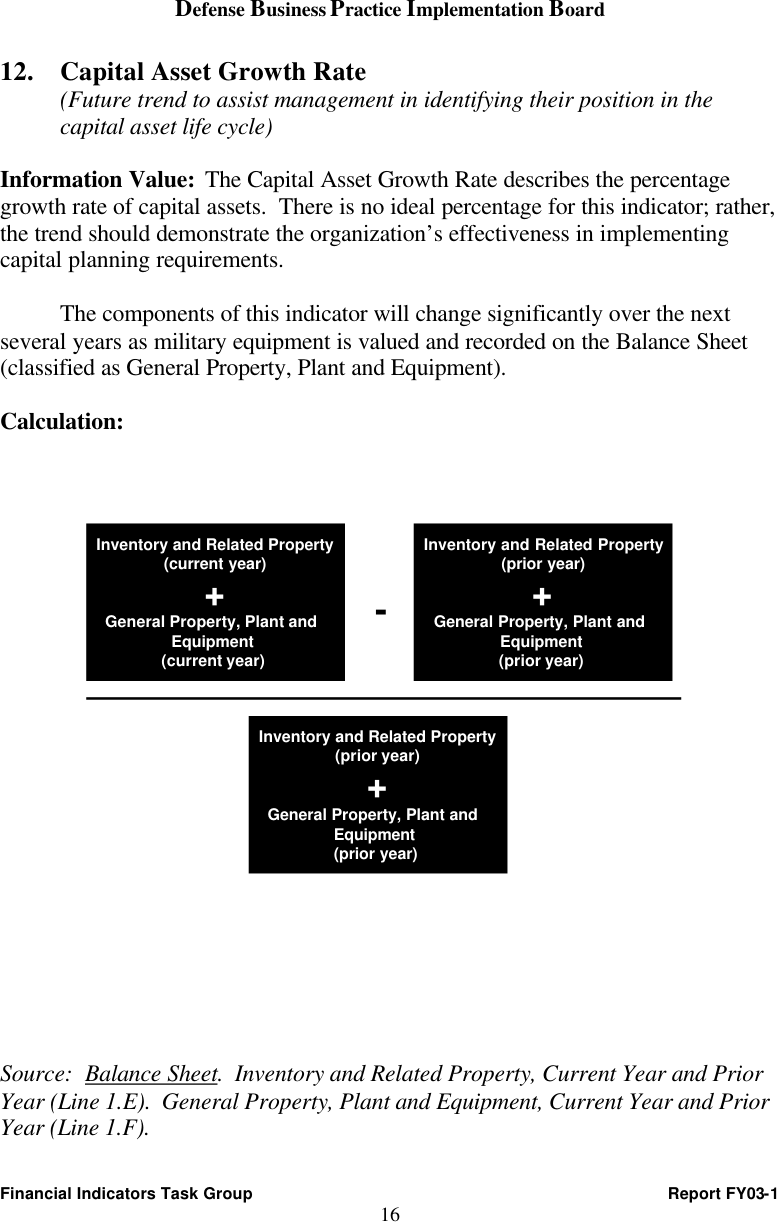
A growth-rate calculation laid out as black boxes: two boxes joined by - over a rule, a third box
beneath, each box holding a labelled sum in bold white type. It is a fraction with no LaTeX on the
page. The grouping the boxes print becomes parentheses in the numerator.
Source page
Source: Defense Business Practice Implementation Board, Financial Indicators Task Group, Report FY03-1, "Capital Asset Growth Rate" (public domain)
Expected output · excerpt
Calculation:
$$\frac{\left(\textbf{Inventory and Related Property (current year)} + \textbf{General Property, Plant and Equipment (current year)}\right) - \left(\textbf{Inventory and Related Property (prior year)} + \textbf{General Property, Plant and Equipment (prior year)}\right)}{\textbf{Inventory and Related Property (prior year)} + \textbf{General Property, Plant and Equipment (prior year)}}$$
…
**Calculation:**

$$\frac{\left(\textbf{Inventory and Related Property (current year)} + \textbf{General Property, Plant and Equipment (current year)}\right) - \left(\textbf{Inventory and Related Property (prior year)} + \textbf{General Property, Plant and Equipment (prior year)}\right)}{\textbf{Inventory and Related Property (prior year)} + \textbf{General Property, Plant and Equipment (prior year)}}$$

<!-- … -->Neighbouring rules, and how they differ
More
Sample sources1 +
Public-domain U.S. federal government source material.
- Defense Business Practice Implementation Board, Financial Indicators Task Group, Report FY03-1, "Capital Asset Growth Rate"
Rule id text-displayed-equations · text formatting math