Is This Even a Table
Aligned content—a table or just a layout?
✅ NormativeSettled. The requirement holds as written.📄 Page ruleCan be applied from the page alone.Read §9.1.5 in the RFC ↗
A region MUST be rendered as a table when, and only when, its rows and columns encode a relation — when the position of a value in the grid is what gives the value its meaning. A region that encodes no relation MUST NOT be rendered as a table.
When it applies
This is the first decision about a region, and every other table rule depends on it. A single page
often shows the whole spectrum at once: real grids, gridded legends, ungridded label: value spec
stacks, address blocks, and two-column prose that looks like a grid but is not.
Same page, three regions:

┌─────────────┬───────────────┐      Motor: 1/2 HP, 115V      ← ungridded spec
│ (1) Premium │ Base rate …   │      Speed: 3-speed              stack: table? text?
│ (2) Losses  │ Incurred …    │
└─────────────┴───────────────┘      Acme Corp
  ↑ gridded legend: table?           123 Main St    ← address block: never a table
Reading the examples. Each one pairs a source page with the output the rule expects. ✅ Sample: the rule applies. ❌ Counter-sample: it looks like it applies and does not, or a rendering got it wrong. A non-conforming output, in red, is shown only for contrast. … marks content left out of an excerpt.
The test
The question is: would this be a <table> in well-written HTML, or a <div> positioned with
CSS?
A border alone does not make a region a table, and alignment alone is not always enough either. The relation decides.
| Strong evidence it is a table | Strong evidence it is not |
|---|---|
| explicit row and column headers | running prose, however neatly it is set in columns |
| repeated records under a shared schema | address blocks |
| a printed grid, or consistent column tracks running down the block | text sitting beside a logo |
| a legend printed as label/definition records inside a grid | decorative alignment with no record schema behind it |
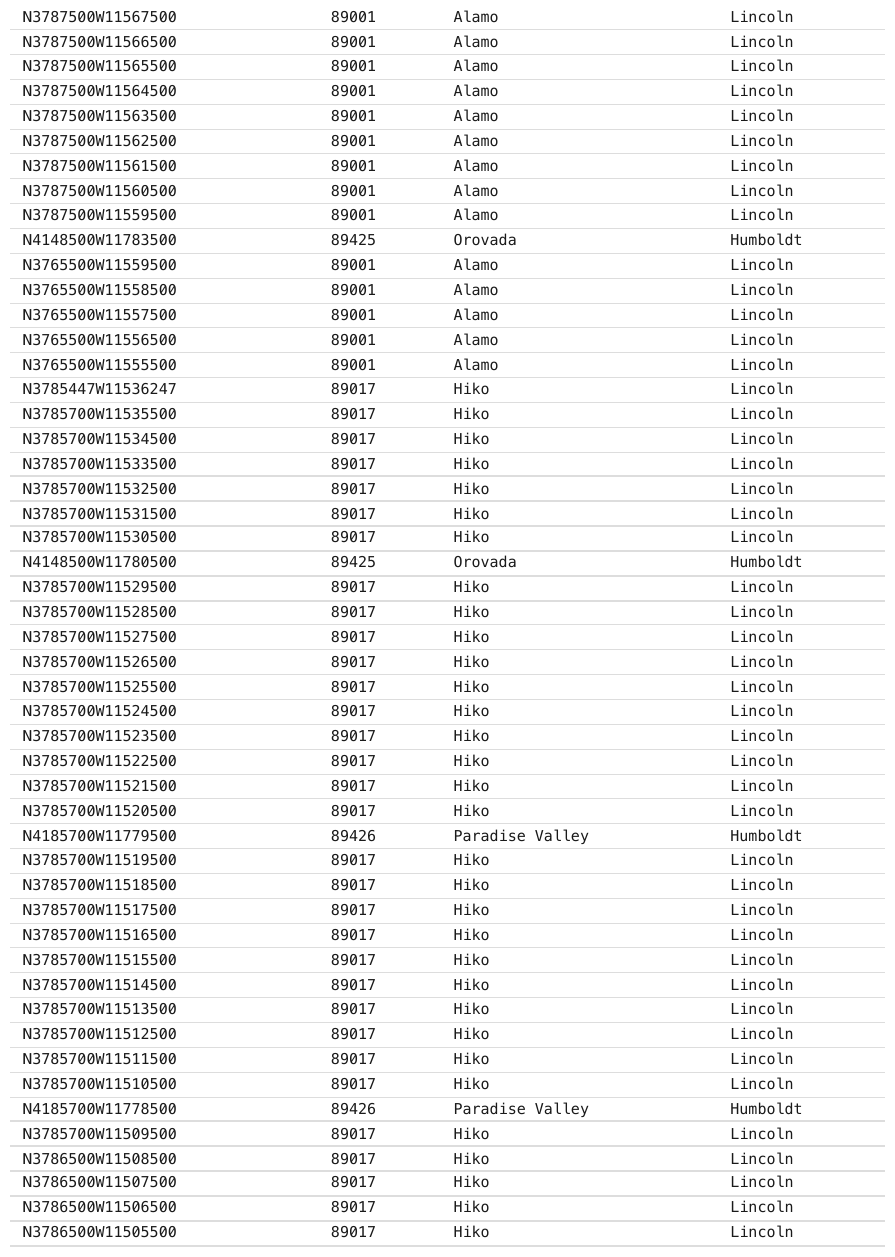
The page starts straight into data rows with no header row4x
Column meaning has to be inferred from the values, which is the edge of the relation test: repeated records under one schema still make it a table, and the output MUST NOT invent the missing header row.
Source page
Expected output · excerpt
| N3787500W11567500 | 89001 | Alamo | Lincoln | |||||||||||||||||||||||||||||||||||||||||||||||||||||||||||||||||||||||||||||||||||||||||||||||
| N3787500W11566500 | 89001 | Alamo | Lincoln | |||||||||||||||||||||||||||||||||||||||||||||||||||||||||||||||||||||||||||||||||||||||||||||||
| N3787500W11565500 | 89001 | Alamo | Lincoln | |||||||||||||||||||||||||||||||||||||||||||||||||||||||||||||||||||||||||||||||||||||||||||||||
| N3787500W11564500 | 89001 | Alamo | Lincoln | |||||||||||||||||||||||||||||||||||||||||||||||||||||||||||||||||||||||||||||||||||||||||||||||
| N3787500W11563500 | 89001 | Alamo | Lincoln | |||||||||||||||||||||||||||||||||||||||||||||||||||||||||||||||||||||||||||||||||||||||||||||||
| N3787500W11562500 | 89001 | Alamo | Lincoln | |||||||||||||||||||||||||||||||||||||||||||||||||||||||||||||||||||||||||||||||||||||||||||||||
| … | ||||||||||||||||||||||||||||||||||||||||||||||||||||||||||||||||||||||||||||||||||||||||||||||||||
Legends and static key-value references are tables
The "Column | Description" box under a rate grid, explaining what (1)–(11) mean, MUST be rendered as a table.
| Column | Description     |
| (1)    | Earned premium  |
| (2)    | Incurred claims |
It looks decorative, but it maps one thing to another, and a mapping is a relation. Omitting it drops real content off the page.
Prose and address blocks are never tables
Two-column running prose only looks like a grid — its columns carry no meaning, they are a typesetting choice. The same holds for an address block, or a caption stacked beside an image. These MUST NOT be rendered as tables.
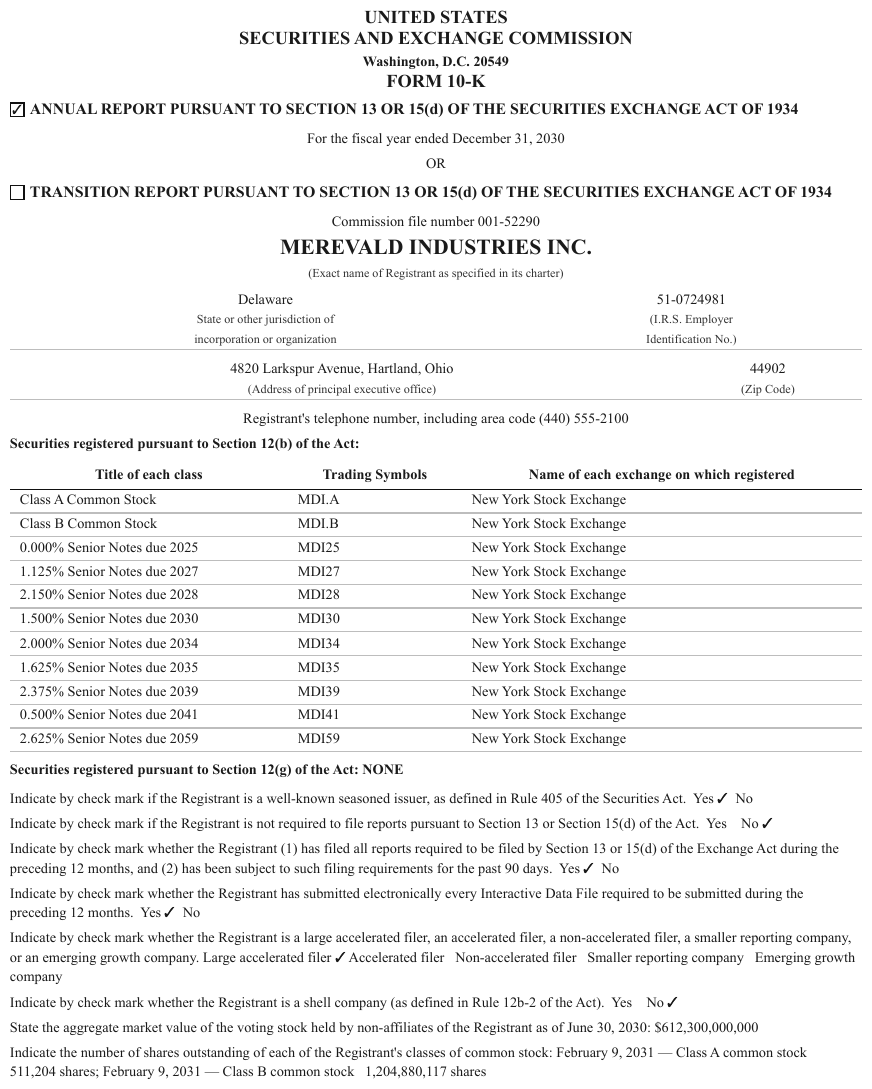
A 10-K cover10k
Yes ✓ No check-mark lines and an address block, both column-shaped, neither
tabular. The genuine table is the small Title of each class / Trading Symbols / Exchange grid.Source page
Expected output · excerpt
Delaware State or other jurisdiction of incorporation or organization
51-0724981 (I.R.S. Employer Identification No.)
4820 Larkspur Avenue, Hartland, Ohio (Address of principal executive office)
44902 (Zip Code)
Registrant's telephone number, including area code (440) 555-2100
Securities registered pursuant to Section 12(b) of the Act:
| Title of each class | Trading Symbols | Name of each exchange on which registered |
|---|---|---|
| Class A Common Stock | MDI.A | New York Stock Exchange |
| Class B Common Stock | MDI.B | New York Stock Exchange |
| 0.000% Senior Notes due 2025 | MDI25 | New York Stock Exchange |
| 1.125% Senior Notes due 2027 | MDI27 | New York Stock Exchange |
| 2.150% Senior Notes due 2028 | MDI28 | New York Stock Exchange |
| 1.500% Senior Notes due 2030 | MDI30 | New York Stock Exchange |
| 2.000% Senior Notes due 2034 | MDI34 | New York Stock Exchange |
| 1.625% Senior Notes due 2035 | MDI35 | New York Stock Exchange |
| 2.375% Senior Notes due 2039 | MDI39 | New York Stock Exchange |
| 0.500% Senior Notes due 2041 | MDI41 | New York Stock Exchange |
| 2.625% Senior Notes due 2059 | MDI59 | New York Stock Exchange |
Securities registered pursuant to Section 12(g) of the Act: NONE
Indicate by check mark if the Registrant is a well-known seasoned issuer, as defined in Rule 405 of the Securities Act. Yes ✓ No
…
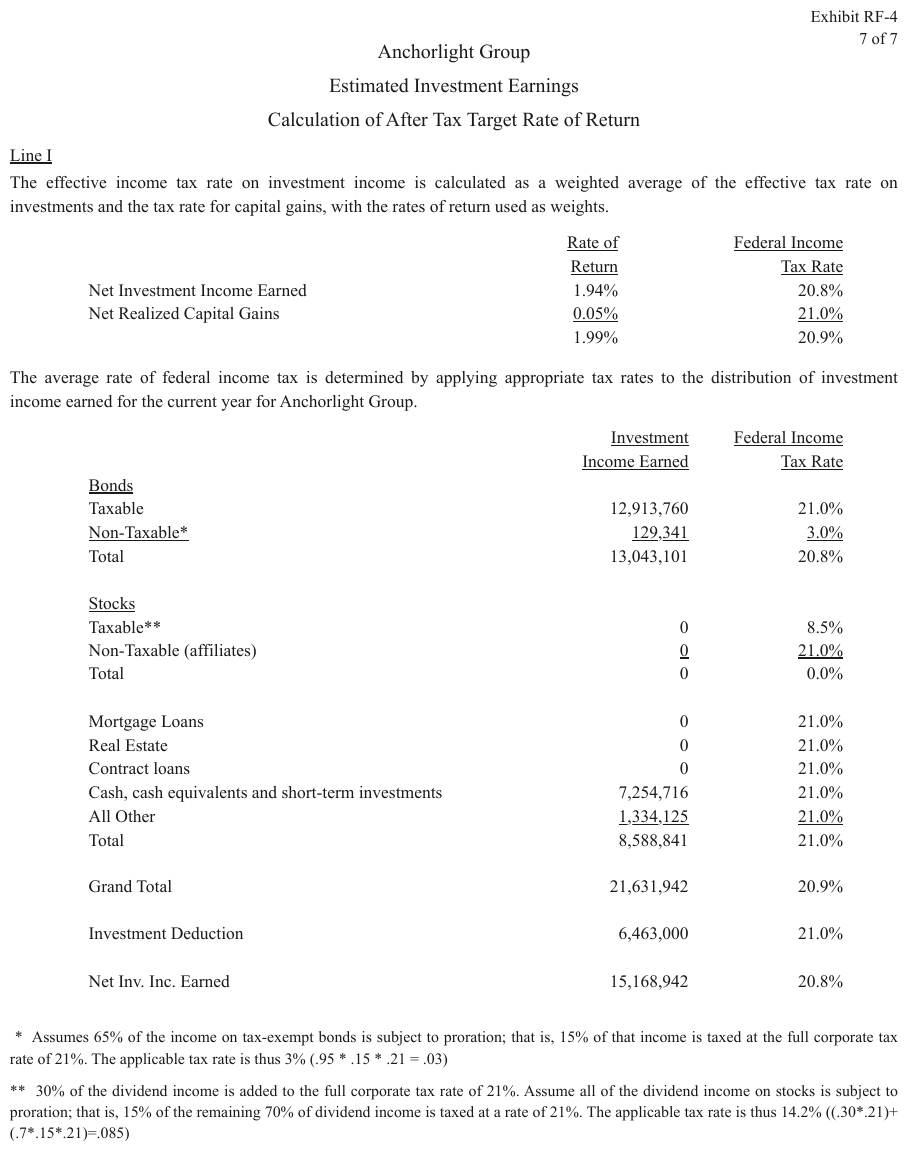
Two real calculation tables surrounded by narrative paragraphsxl
The prose is not a table however neatly it sits between them. Each column header is one label wrapped over two lines, so each is a single header cell, not a two-row tier (see Header Wrap vs Real Tier (§9.3.2)).
Source page
Expected output · excerpt, table 1 of 2
Line I
The effective income tax rate on investment income is calculated as a weighted average of the effective tax rate on investments and the tax rate for capital gains, with the rates of return used as weights.
| Rate of Return | Federal Income Tax Rate | |
|---|---|---|
| Net Investment Income Earned | 1.94% | 20.8% |
| Net Realized Capital Gains | 0.05% | 21.0% |
| 1.99% | 20.9% |
The average rate of federal income tax is determined by applying appropriate tax rates to the distribution of investment income earned for the current year for Anchorlight Group.
…
Label / value blocks without a grid
Two columns of labels and values with no ruled grid are a table or key-value content depending on the data, not the layout. The same two whitespace tracks can hold either.
| The rows are… | Rendering | Examples |
|---|---|---|
| Records of one kind — every label is paired with the same kind of value (an amount per component, a factor per year) | a table, even with no header row and no ruled grid | a Working Capital panel (see Borderless Whitespace Tables (§9.1.1)); the Trend Factors block of wwa below |
| Different kinds of fact — each label names its own field (a filing number, a state, a date) | key-value content — see Forms and Key-Value Regions (§10.1) | filing metadata, a spec sheet, a biography's Name: / Affiliation: lines |
| Headline figures — labelled KPIs set as tiles or a highlight panel | stat tiles — see Stat Tiles (§5.11) | Out-of-home +26.5% |
A bold label with its value flowing after it — blower spec sheets and similar — is the second kind.
**Motor**: 1/2 HP, 115V      ← no ruled grid, value flows after the label
**Airflow**: 1,200 CFM
A stack whose labels name different kinds of fact MUST NOT be rendered as a table unless a ruled grid is printed around it; it is key-value content, and every line of it MUST still appear in the output. A stack whose rows are records of one kind MUST be rendered as a table.
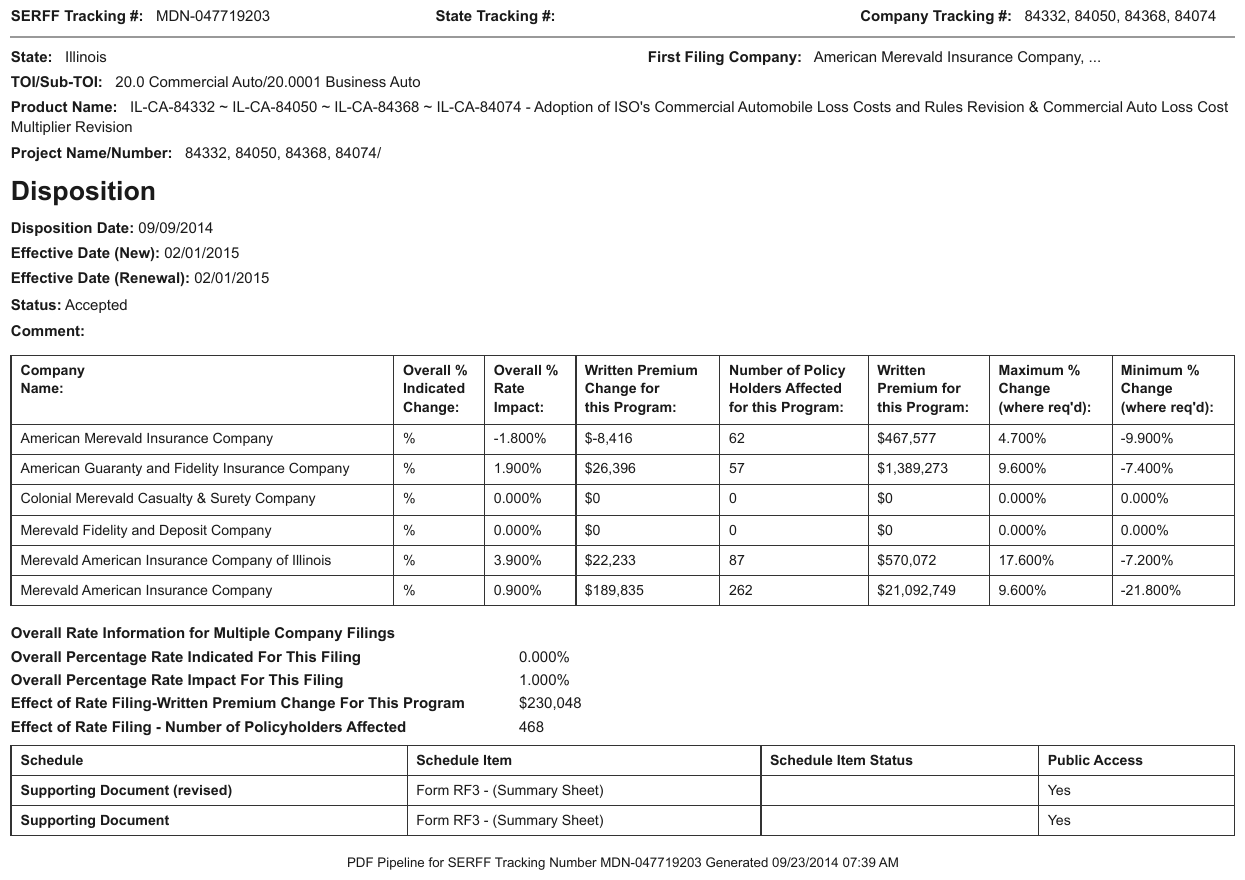
The SERFF filing metadata is a label:value stackratefiling
The SERFF filing metadata is a label:value stack — SERFF Tracking #, State at the top, a separate Disposition block below. Both read as two columns; neither is a table. The two ruled grids further down the same page are.
Source page
Expected output · excerpt, table 1 of 2
- SERFF Tracking #: MDN-047719203
- State Tracking #: [blank]
- Company Tracking #: 84332, 84050, 84368, 84074
- State: Illinois
- First Filing Company: American Merevald Insurance Company, ...
- TOI/Sub-TOI: 20.0 Commercial Auto/20.0001 Business Auto
- Product Name: IL-CA-84332 ~ IL-CA-84050 ~ IL-CA-84368 ~ IL-CA-84074 - Adoption of ISO's Commercial Automobile Loss Costs and Rules Revision & Commercial Auto Loss Cost Multiplier Revision
- Project Name/Number: 84332, 84050, 84368, 84074/
Disposition
- Disposition Date: 09/09/2014
- Effective Date (New): 02/01/2015
- Effective Date (Renewal): 02/01/2015
- Status: Accepted
- Comment: [blank]
| Company Name: | Overall % Indicated Change: | Overall % Rate Impact: | Written Premium Change for this Program: | Number of Policy Holders Affected for this Program: | Written Premium for this Program: | Maximum % Change (where req'd): | Minimum % Change (where req'd): |
|---|---|---|---|---|---|---|---|
| American Merevald Insurance Company | % | -1.800% | $-8,416 | 62 | $467,577 | 4.700% | -9.900% |
| American Guaranty and Fidelity Insurance Company | % | 1.900% | $26,396 | 57 | $1,389,273 | 9.600% | -7.400% |
| Colonial Merevald Casualty & Surety Company | % | 0.000% | $0 | 0 | $0 | 0.000% | 0.000% |
| Merevald Fidelity and Deposit Company | % | 0.000% | $0 | 0 | $0 | 0.000% | 0.000% |
| Merevald American Insurance Company of Illinois | % | 3.900% | $22,233 | 87 | $570,072 | 17.600% | -7.200% |
| Merevald American Insurance Company | % | 0.900% | $189,835 | 262 | $21,092,749 | 9.600% | -21.800% |
…
The bottom Trend Factors block (6th Prior Year … Most Recent Year) has no grid and no…wwa
The bottom Trend Factors block (6th Prior Year … Most Recent Year) has no grid and no header, but every row is the same kind of record — a year and its trend factor — so it is a table, with its bold label as text above it. The large premium-trend grid above it and the ruled Rolling 4-Qtr box are tables too.
Source page
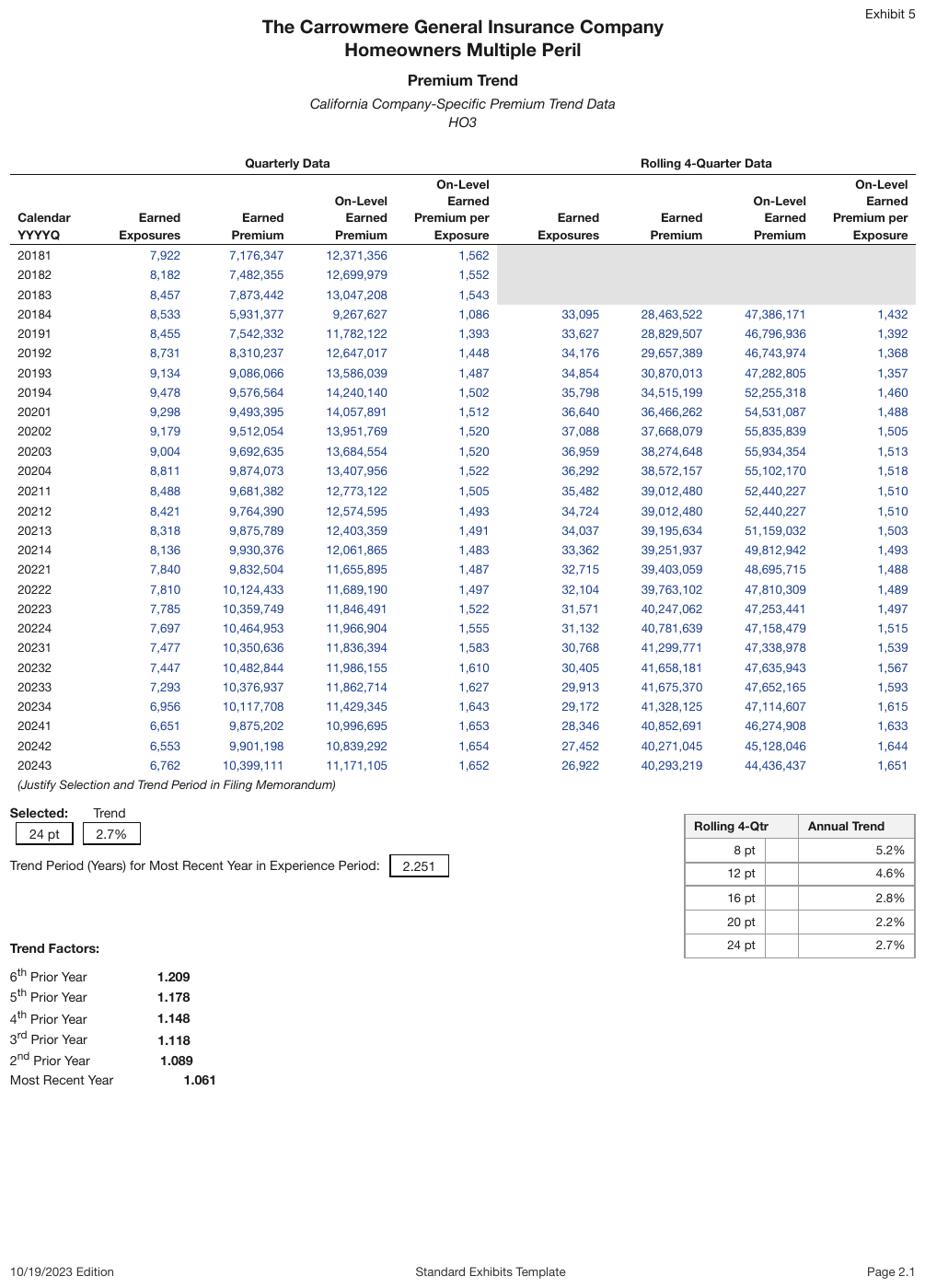
Expected output · excerpt, main table and the Trend Factors block
| Quarterly Data | Rolling 4-Quarter Data | |||||||||||||||||||||||||||||||||||||||||||||||||||||||||||||||||||||||||||||||||||||||||||||||||
|---|---|---|---|---|---|---|---|---|---|---|---|---|---|---|---|---|---|---|---|---|---|---|---|---|---|---|---|---|---|---|---|---|---|---|---|---|---|---|---|---|---|---|---|---|---|---|---|---|---|---|---|---|---|---|---|---|---|---|---|---|---|---|---|---|---|---|---|---|---|---|---|---|---|---|---|---|---|---|---|---|---|---|---|---|---|---|---|---|---|---|---|---|---|---|---|---|---|---|
| Calendar YYYYQ | Earned Exposures | Earned Premium | On-Level Earned Premium | On-Level Earned Premium per Exposure | Earned Exposures | Earned Premium | On-Level Earned Premium | On-Level Earned Premium per Exposure | ||||||||||||||||||||||||||||||||||||||||||||||||||||||||||||||||||||||||||||||||||||||||||
| 20181 | 7,922 | 7,176,347 | 12,371,356 | 1,562 | ||||||||||||||||||||||||||||||||||||||||||||||||||||||||||||||||||||||||||||||||||||||||||||||
| 20182 | 8,182 | 7,482,355 | 12,699,979 | 1,552 | ||||||||||||||||||||||||||||||||||||||||||||||||||||||||||||||||||||||||||||||||||||||||||||||
| 20183 | 8,457 | 7,873,442 | 13,047,208 | 1,543 | ||||||||||||||||||||||||||||||||||||||||||||||||||||||||||||||||||||||||||||||||||||||||||||||
| 20184 | 8,533 | 5,931,377 | 9,267,627 | 1,086 | 33,095 | 28,463,522 | 47,386,171 | 1,432 | ||||||||||||||||||||||||||||||||||||||||||||||||||||||||||||||||||||||||||||||||||||||||||
| 20191 | 8,455 | 7,542,332 | 11,782,122 | 1,393 | 33,627 | 28,829,507 | 46,796,936 | 1,392 | ||||||||||||||||||||||||||||||||||||||||||||||||||||||||||||||||||||||||||||||||||||||||||
| 20192 | 8,731 | 8,310,237 | 12,647,017 | 1,448 | 34,176 | 29,657,389 | 46,743,974 | 1,368 | ||||||||||||||||||||||||||||||||||||||||||||||||||||||||||||||||||||||||||||||||||||||||||
| … | ||||||||||||||||||||||||||||||||||||||||||||||||||||||||||||||||||||||||||||||||||||||||||||||||||
…
Trend Factors:
| 6th Prior Year | 1.209 |
| 5th Prior Year | 1.178 |
| 4th Prior Year | 1.148 |
| 3rd Prior Year | 1.118 |
| 2nd Prior Year | 1.089 |
| Most Recent Year | 1.061 |
Form intertwined with a grid
Rate-filing pages that are half form, half table.
Insurer: [blank]   NAIC #: [blank]     ← form fields…
| Year | Rate change |
| 2024 | +4.2%       |               ← …and a genuine grid, same page
The ruled grid region MUST be rendered as a table and the form fields as key-value content, so that nothing printed is lost. The table MUST NOT be stretched to swallow the form fields, and the grid MUST NOT be dropped because the page as a whole reads like a form.
Cases the relation test does not settle on its own
The relation test alone MUST NOT decide these cases; each is governed by its own rule:
- forms and ungridded key-value (Forms and Key-Value Regions (§10.1))
- trailing totals outside a frame (Bottom Edge Totals and Islands (§9.7.1))
- a printed data grid under a chart (Chart With a Printed Data Grid (§9.1.2))
- detached aligned cells
Why the cost runs both ways
A missed legend makes a real relation vanish from the output (never drop). A decorative box rendered as a table asserts structure the page never claimed (never invent). Neither error is recoverable downstream, which is why the relation test — not the border, not the alignment — decides.
two-column author biographies
Two columns, each with bold labels — Name:, Affiliation:, Address:, Main Works: — and
values beneath them, separated by horizontal rules top and bottom. Every visual cue says table:
aligned label column, ruled boundaries, repeated schema across the two halves.
It is not one. The two columns are independent biographies, not two records of one relation,
and the rule lines are section dividers rather than a grid. Reading it as a table would pair
Marcus Ainsley with Priya Delacroix as though they shared a row.
The label/value blocks inside each column are ungridded key-value content — see Forms and Key-Value Regions (§10.1) — and the bulleted publication lists are ordinary lists. The columns are unrolled in reading order, left biography first.
Source page

Expected output · excerpt, below the running head
A grey silhouette portrait placeholder.
Name: Marcus Ainsley
Affiliation: Dr. Visiting Lecturer, Information, Production and Systems Research Center, Bramwell University
Address: 14-9 Farrowfield, Ashcombe-ku, Renwick 220-0114, Freldova
Brief Biographical History: 1998 Received M. Eng. Sci. degree from University of Dunwich 2006 Received Ph.D. degree from Graduate School of Information, Production and Systems, Bramwell University 2006- Visiting Lecturer at Bramwell University
Main Works:
- “Layered Rule Induction for Sparse Transaction Streams,” Journal of Applied Adaptive Systems, Vol.9, No.1, pp. 98-107, 2005.
- “Pruning Association Graphs with Bootstrap Confidence Bounds,” In Proc. of the Freldova Conference on Learning Systems, pp. 5220-5226, 2005.
Membership in Academic Societies:
- Institute of Electrical and Electronics Engineers (IEEE)
- The Society of Instrument and Control Engineers (SICE)
- The Information Processing Society of Freldova (IPSF)
A grey silhouette portrait placeholder.
Name: Priya Delacroix
Affiliation: Dr. Professor, Graduate School of Information, Production and Systems, Bramwell University
Address: 14-9 Farrowfield, Ashcombe-ku, Renwick 220-0114, Freldova
Brief Biographical History: 1965 Joined Halloway Corp. 1991- Professor at Renwick University 2001- Professor at Bramwell University
Main Works:
- “Cooperative Foraging in Heterogeneous Agent Colonies,” Bramwell Review of Control and Autonomy –Part B–, Vol.34, No.1, pp. 168-182, 2005.
- “A Moment-Based Observer for Granular Mill Loading,” Transactions of the Freldova Control Society, Vol.11, Issue 6, pp. 786-799, November 2003.
Membership in Academic Societies:
- Institute of Electrical and Electronics Engineers (IEEE)
- Association for Computing Machinery (ACM)
- The Society of Instrument and Control Engineers (SICE)
Neighbouring rules, and how they differ
More
Rule id tables-is-this-even-a-table · tables detection boundaries